
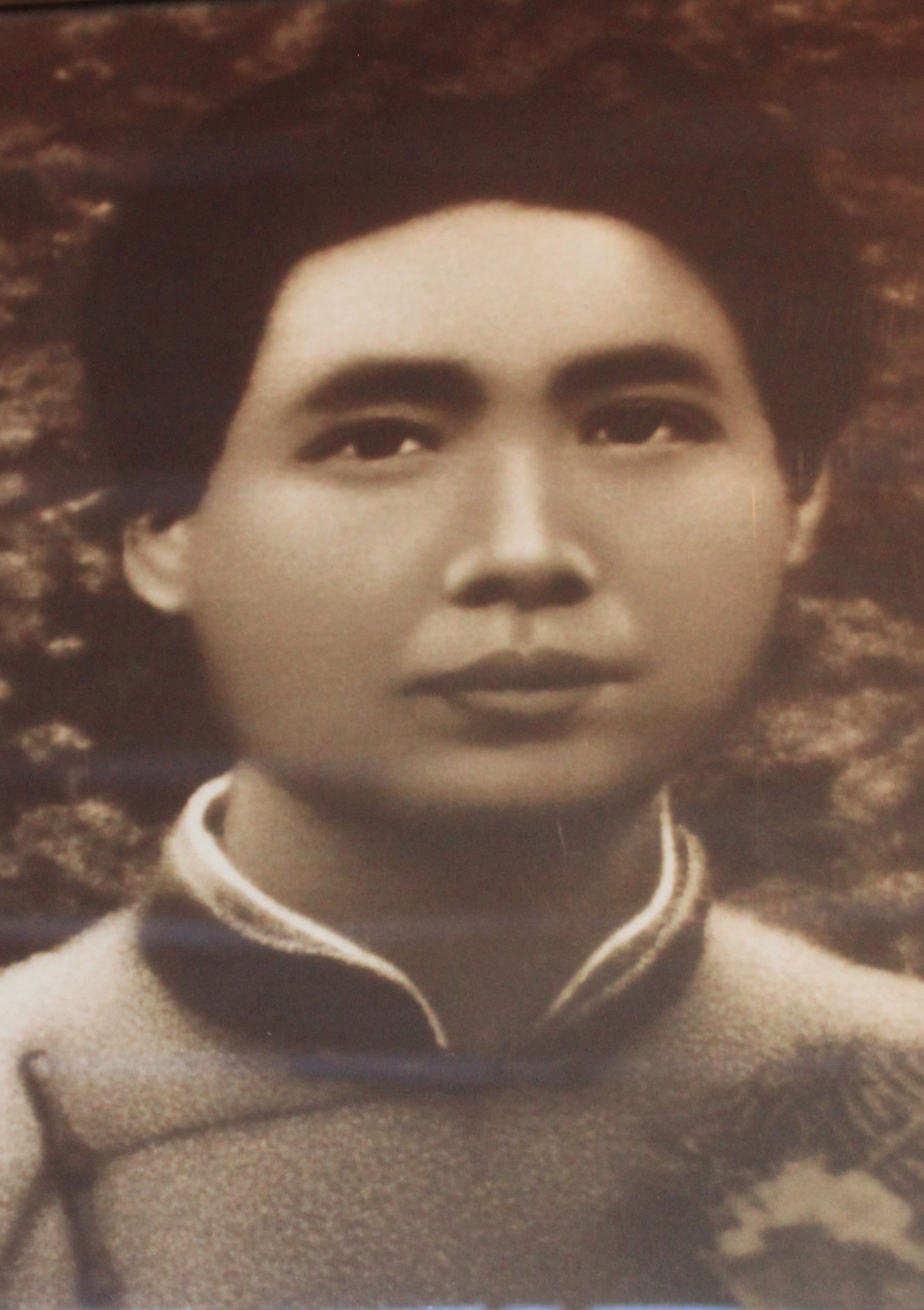
A Young Mao Zedong
I’m not sure I like Mao Zedong. This was reinforced by reading Jung Chang’s book Mao: The Unknown Story, in which she describes how ruthless he was, both towards his fellow communists in the pursuit of power and towards his own family. I suspect this account of hers is a little biased. But I have no way of telling. It is based on spoken accounts, not on written material and therefore is not accepted by academics as being a true historical piece of work. What I do know is that here in Shanghai I have seen no remnants of his personality cult which was still everywhere in China in the 1980s. In fact there is very little of Mao anywhere to be seen here in Shanghai. Reading Peter Hessler’s River Town: Two Years on the Yangtze gave me something that is helping me deal with my ideas about Mao. It was written by one of his Chinese students in his english class in Fuling in the late 1990s:
I think in the history of the People’s Republic of China, there are two great men: Mao Zedong and Deng Xiaoping. We should mention the two men if we want to point out the difference between two generations’ views on China
When my parents were at my age, China wasn’t rich. Even the people couldn’t live the type of dressing warmly and eating there fill. The situation was very hard at that time. Because of lack of experience, the leaders of China didn’t solve some questions very well. Maybe, that period, was the hardest within the progress of China. But, there is a fact that is beyond all question: it was Mao Zedong and his comrades that founded the People’s Republic of China, and brought the Chinese people independence and democracy which is a long cherished goal for the Chinese. So, people admired him from the bottom of their heart. This kind of admiration led to people’s profound love of China to a great extent. My parents did the same. It was the Great Cultural Revolution then; there were many things wrong in life. But they thought China was the best and perfect country and had splendid position. In their minds, China would reach its great goal only by performing planned economy because it was a socialist country. Anything about market economy was Right deviation. My parents only did what they were ordered to do and didn’t consider whether they were true or false.
Today, when we see those days with our own sight, we’ll feel our parents’ thoughts and actions are somewhat blind and fanatical. But if we consider that time objectively, I think, we should understand and can understand them. Each generation has its own happiness and sadness. To younger generation, the important thing is understanding instead of criticising. Our elder generation was unlucky; they didn’t own a good chance and circumstances to realize their value. But, their spirit, their love to our country set a good example to us.
Having read this I now feel able to put together a piece about Chairman Mao that has been hanging around for several months. Without this I have found it difficult to reconcile the conflicting facts I have acquired en route. (I am no historian after all, as a chemist I am only trained in the behaviour of atoms and electrons, not in people, their languages, their histories or their politics.) So here we go:
As a port and westernised at that, Shanghai was the centre of China’s slow industrialisation and a focal point for revolutionaries such as Dr. Sun Yat-sen and his wife Soong Ching Ling, and early members of the Chinese Communist Party. This core of revolutionary thought brought people interested in over-throwing the feudal system from all over the country to Shanghai. Some came to visit; some came to live in the early years of the 20th Century. One such person was Chairman Mao.
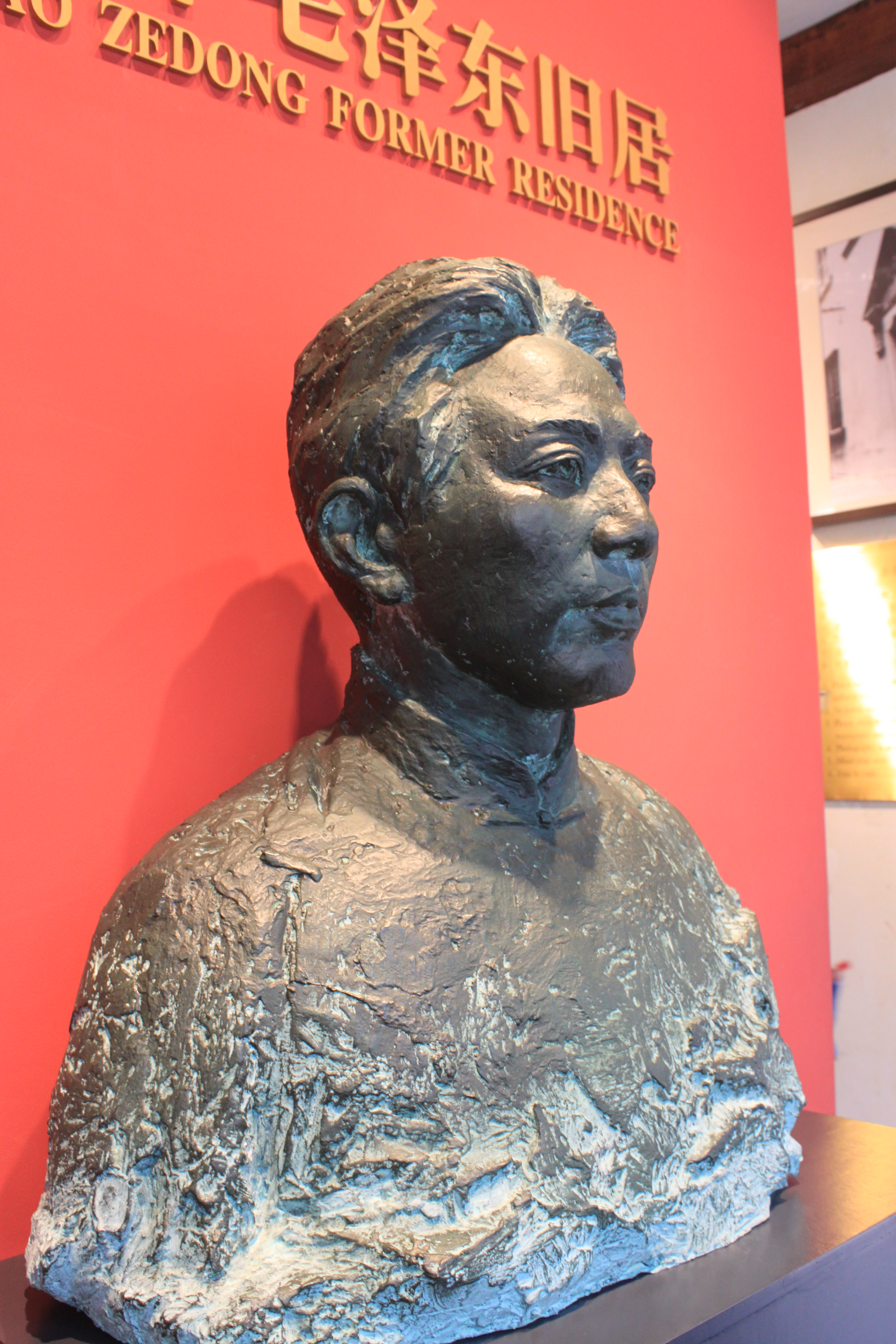
Bust of Mao Zedong
Mao Zedong was the son of a wealthy farmer from Hunan Province, south west of Shanghai, but in his teenage years Mao turned his back on his father’s successful farm and spent his time reading voraciously. Photographs of his family show his brother and parents in typical farmers attire, whereas he is wearing the clothes typical of an early 20th Century man from Shanghai the changshan (literally a long shirt). He aspired to leave his farming roots and become a scholar. He was later bullied at school for his peasant background. He read voraciously about history, in particular about the Napoleonic and other wars and took a great interest in WWI and was informed by riots resulting from famine in his home town.
Mao was attracted to the revolutionaries of the time, particularly Chen Duxiu who had been a leading figure in the May Fourth Movement which protested at The Treaty of Versailles’ decision to hand over German land in China to Japan. In 1917 he found a job working for the librarian Li Dazhao at Beijing university whose boss was Cai Yuanpei, the revolutionary thinker and the president of Beijing University. Li Dazhao and Chen Duxiu, the dean of the university, founded the Chinese Communist party in 1920/1 (reports are conflicting). Mao had many discussions with Chen Duxiu, which transformed Mao from a radical nationalist to a Marxist-Leninist in the clandestine Marxist meetings at the university.
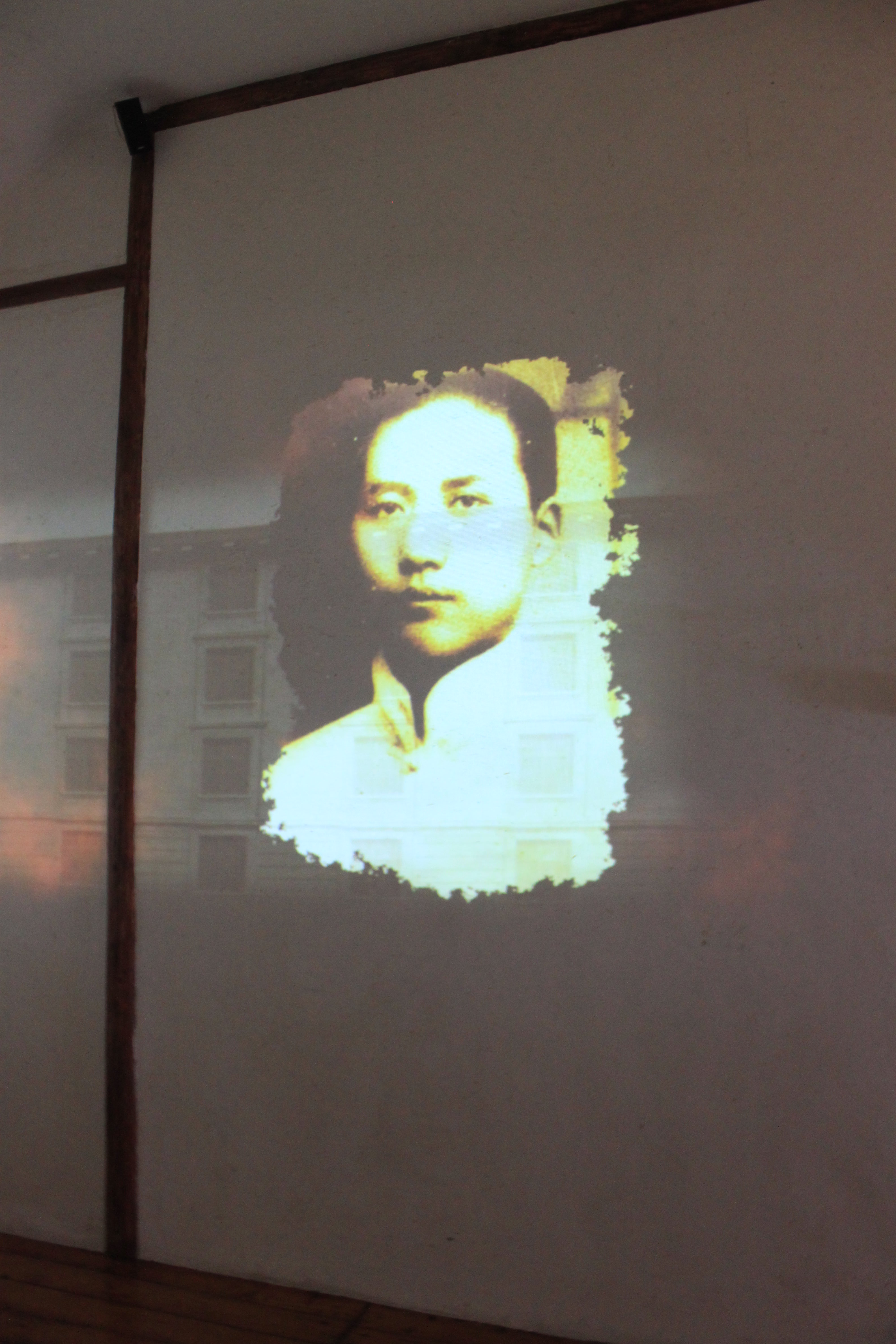
Mao Zedong
From 1919 to 1920 Mao visited Shanghai three times. One of the reasons was to say good-bye to a group of Students bound for a work-study program in Paris. Some of the 196 students were from Hunan, others included Zhou Enlai (later Premier of the CCP from 1949 – 1976) who had been to university in Japan, had witnessed the Fourth of May Movement in Tianjin and on his return set up the “Awakening Society” similar to Li Dazhao’s group.
“After returning from Shanghai to Hunan, Mao Zedong, set about organizing Changsha Communist Group. In July 1921, as a representative of Hunan, he came to Shanghai to attend the First National Congress of the Chinese Communist Party. From then on, his name was closely linked to the revolutionary cause of the Chinese people.”
I have been to visit three houses where Mao Zedong stayed whilst in Shanghai, although he has visited the city “tens of times”.
63 Anyi Road (formerly No. 29 Min Hou Nan Lane Min on Hatong Road)
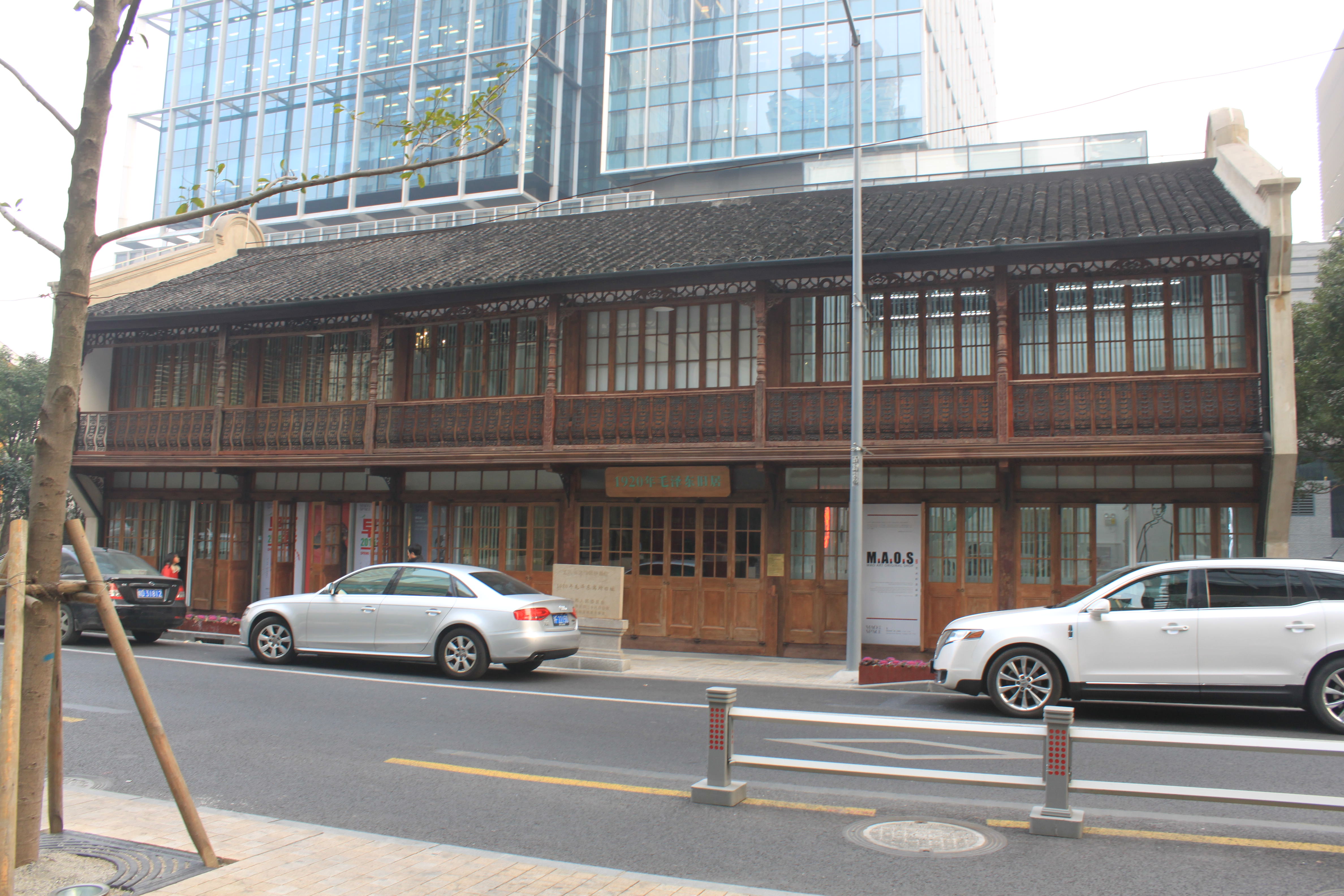
63 Anyi Road Shanghai
The first former residence of Mao Zedong I visited is at 63 Anyi Road (formerly 29 Minhou Alley) is near to the Jing’an Temple. This preserved terraced Shikumen house, is where Chairman Mao lived from May to July 1920 the third time that he came to Shanghai. The front room is filled with photographs and writings of the Chairman.
Here I am told that “Shanghai is the birthplace of the Communist Party of China (CPC). As a young man, Mao Zedong, founder of the party, resided at No. 63 Anyi Road for a brief but critical period.”
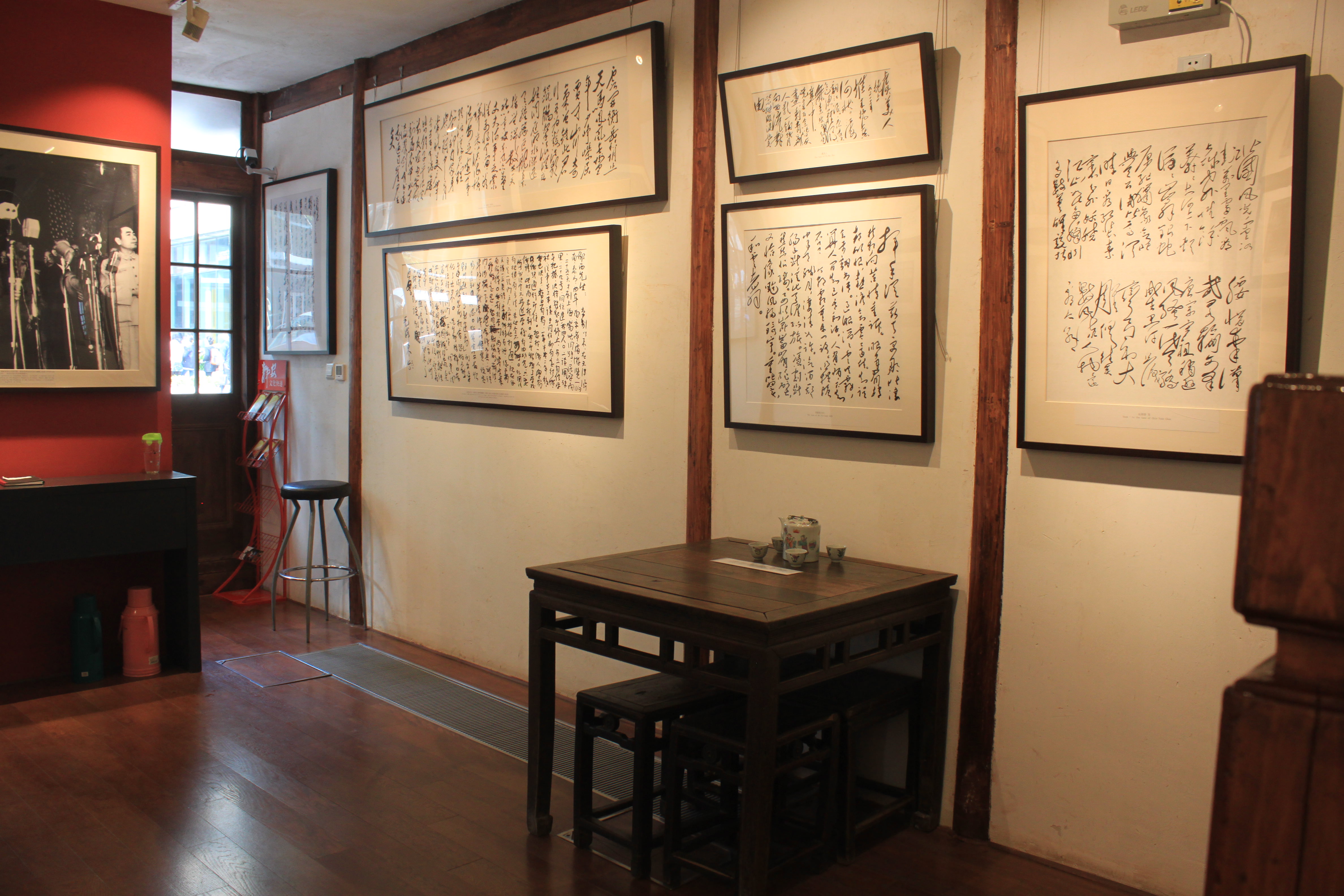 I am told that during this critical period Mao “paid many visits to Chen Duxiu to discuss Marxist principles; and thus the seeds of the CPC began to germinate”. Here too, I am told that “he was an extraordinary poet and astute politician, observing the world and coming to know it deeply.” I was curious about his poetry as I had learned sometime ago that he and a fellow student had fed themselves on a walking tour through Hunan by writing literary couplets in return for meals. This is an example of his poetry which was written on The Long March between 1934-5.
Mountain.
I whip my quick horse and don’t dismount
and look back in wonder.
The sky is three feet away.
Mountain.
The sea collapses and the river boils.
Innumerable horses race
insanely into the peak of battle.
Mountain.
Peaks pierce the green sky, unblunted..
The sky would fall
but for the columns of mountains.
It has to be said that it is quite extraordinary poetry. Perhaps the merit of it has been lost in translation. Wikipedia tells me that “Arthur Waley, the eminent British translator of Chinese literature, …….. described Mao’s poetry as “not as bad as Hitler’s paintings, but not as good as Churchill’s.”
“On May 8, 1920 Mao and members of the Shanghai Ximin Society participated in a rally at Bansong Garden to discuss their association business and provide a send-off to the students who were departing for France.”
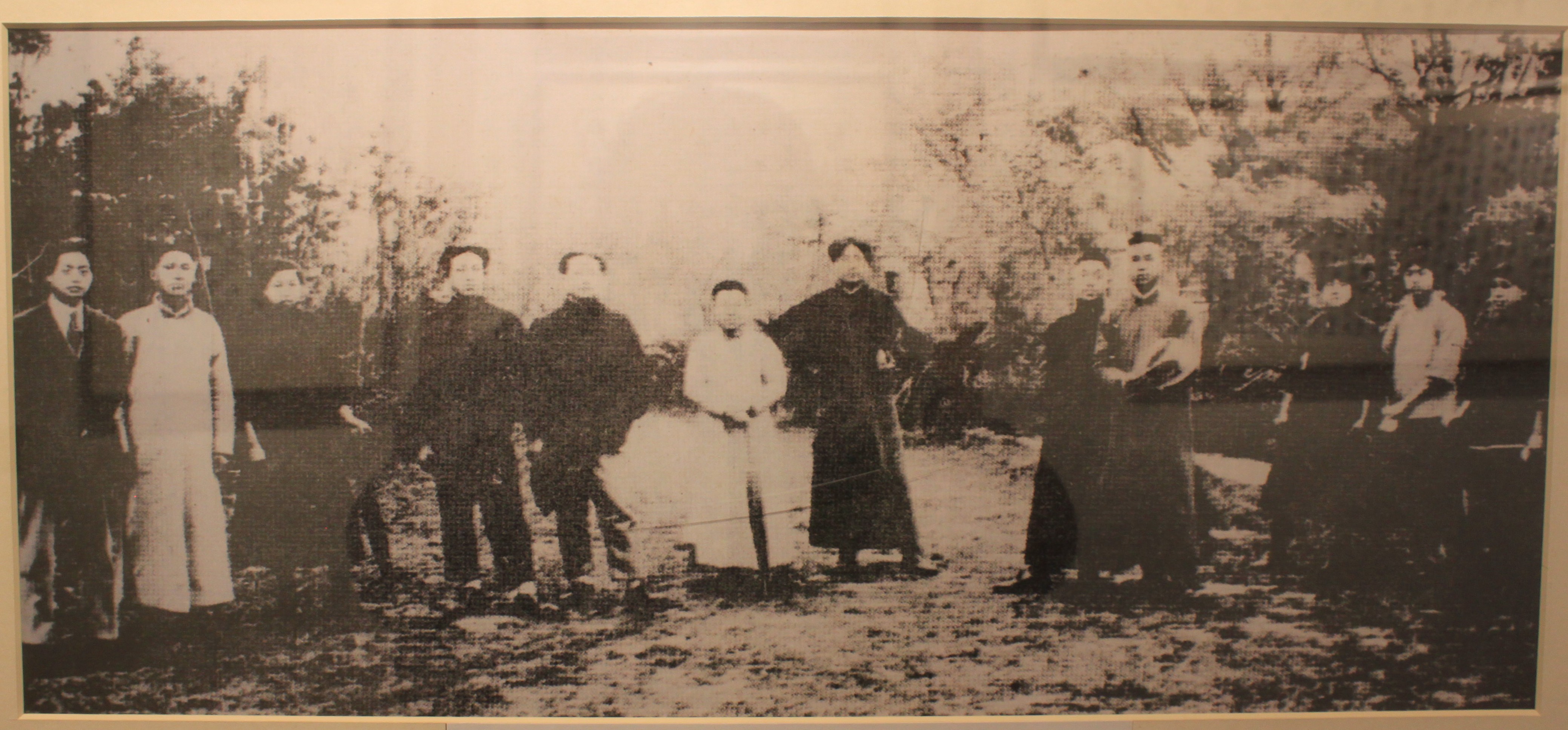
Banging Garden Mao 7th from left
Whilst living in this house on May 8th 1920, Mao joined a gathering at Bansongyuan Road, which elsewhere in Shanghai was described as “to say farewell to the students who were departing for France” of whom Zhou Enlai was one. Here I’m told that the meeting was to discuss the Changsha Xinmin Society business – how to accept new members that follows the values of the society and Marxism – (to which Mao was first introduced by his Professor Yang Changji at Hunan First Normal College 1913 -1918) – how it would expand and accept new members.
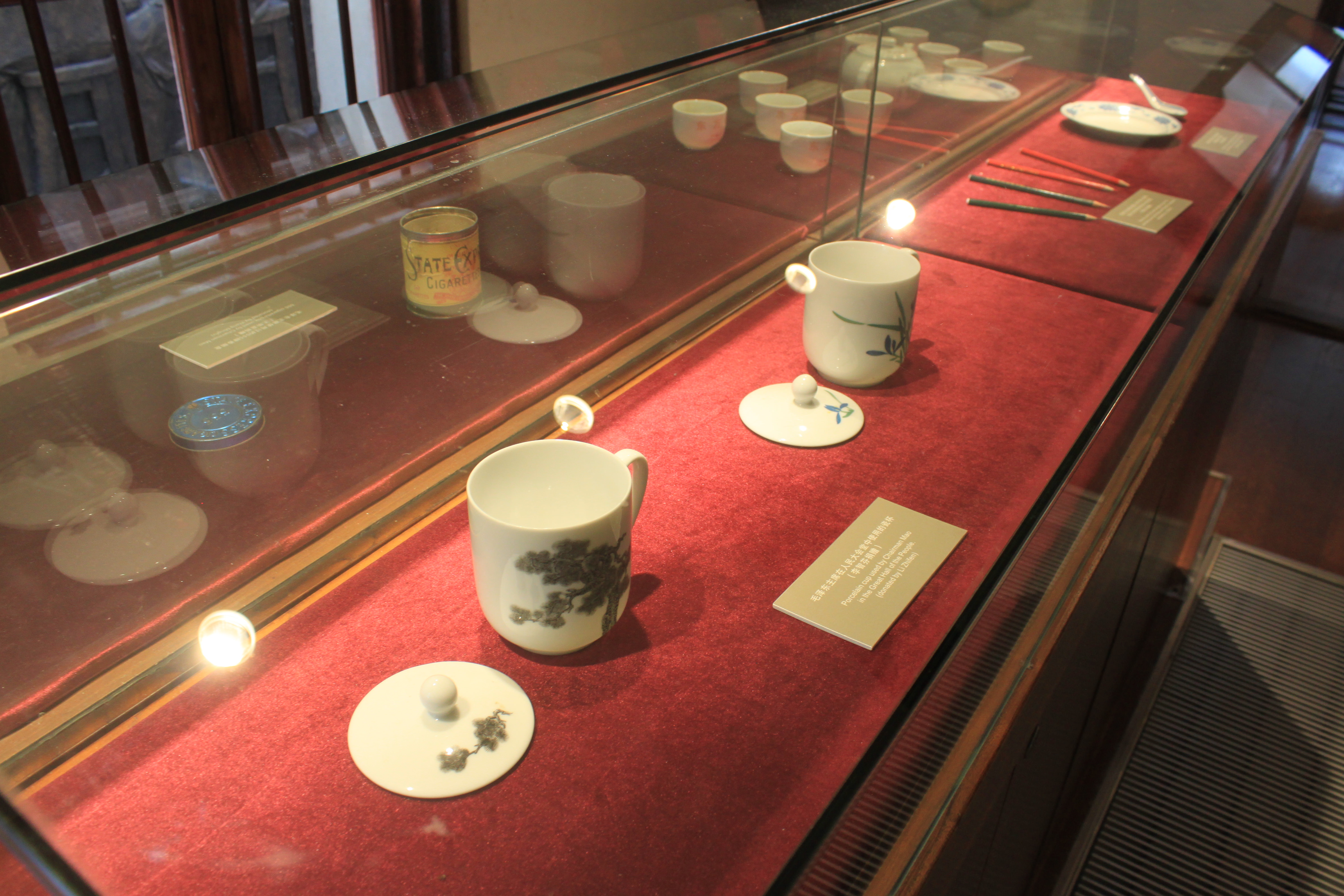
Chairman Mao memorabilia
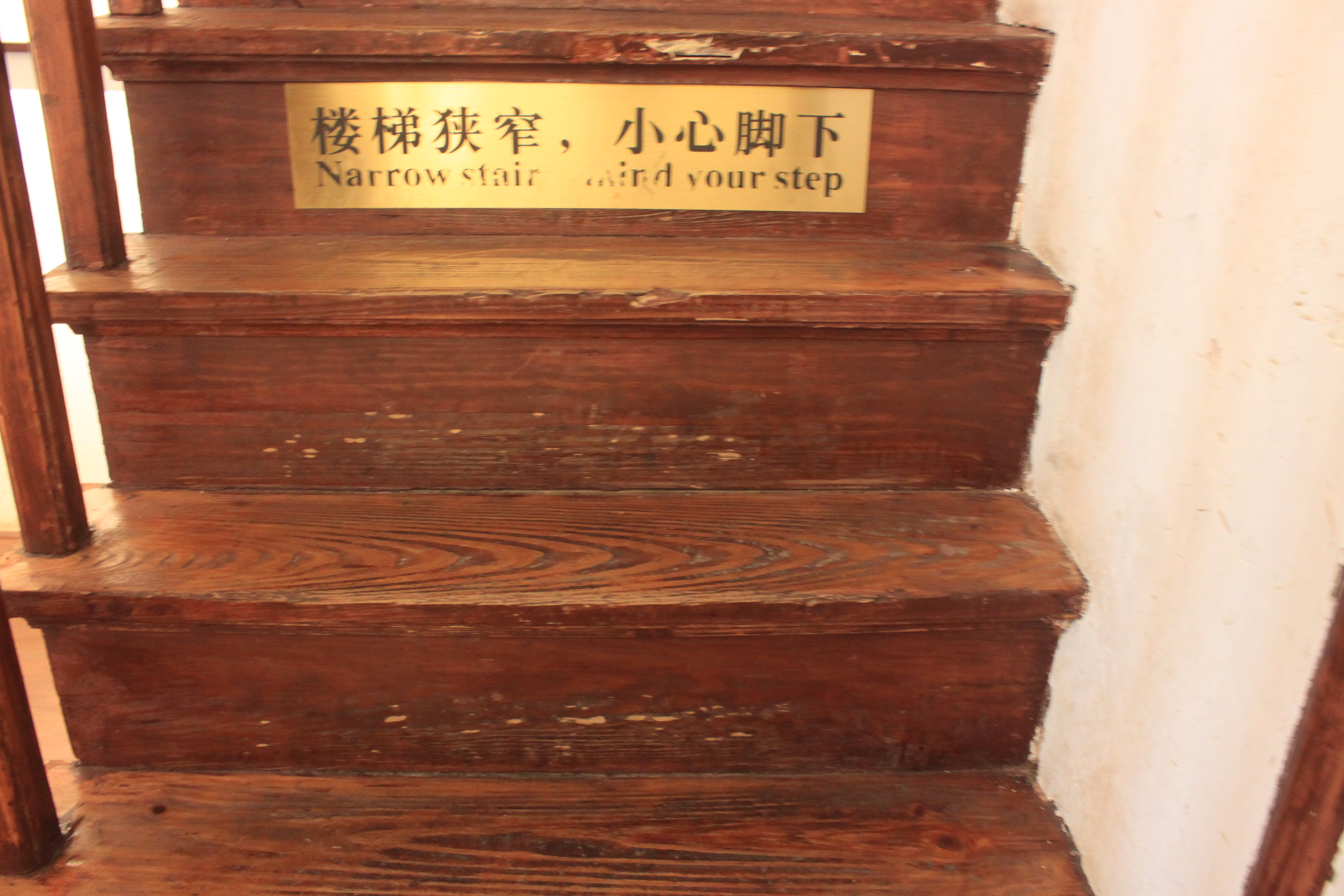
Narrow steps to 1st floor
In the small back room which was the kitchen are items used by Mao Zedong (but they were not, as the guide pointed out to me, used within these four walls). More of the “Mao Zedong once used this cup when he visited the No.1 workers factory” type of memorabilia. The steps up to the top floor were incredibly narrow, with a sign to tell you so – so narrow in fact that going up the steps on tip toe or with your feet sideways was the only way to go.
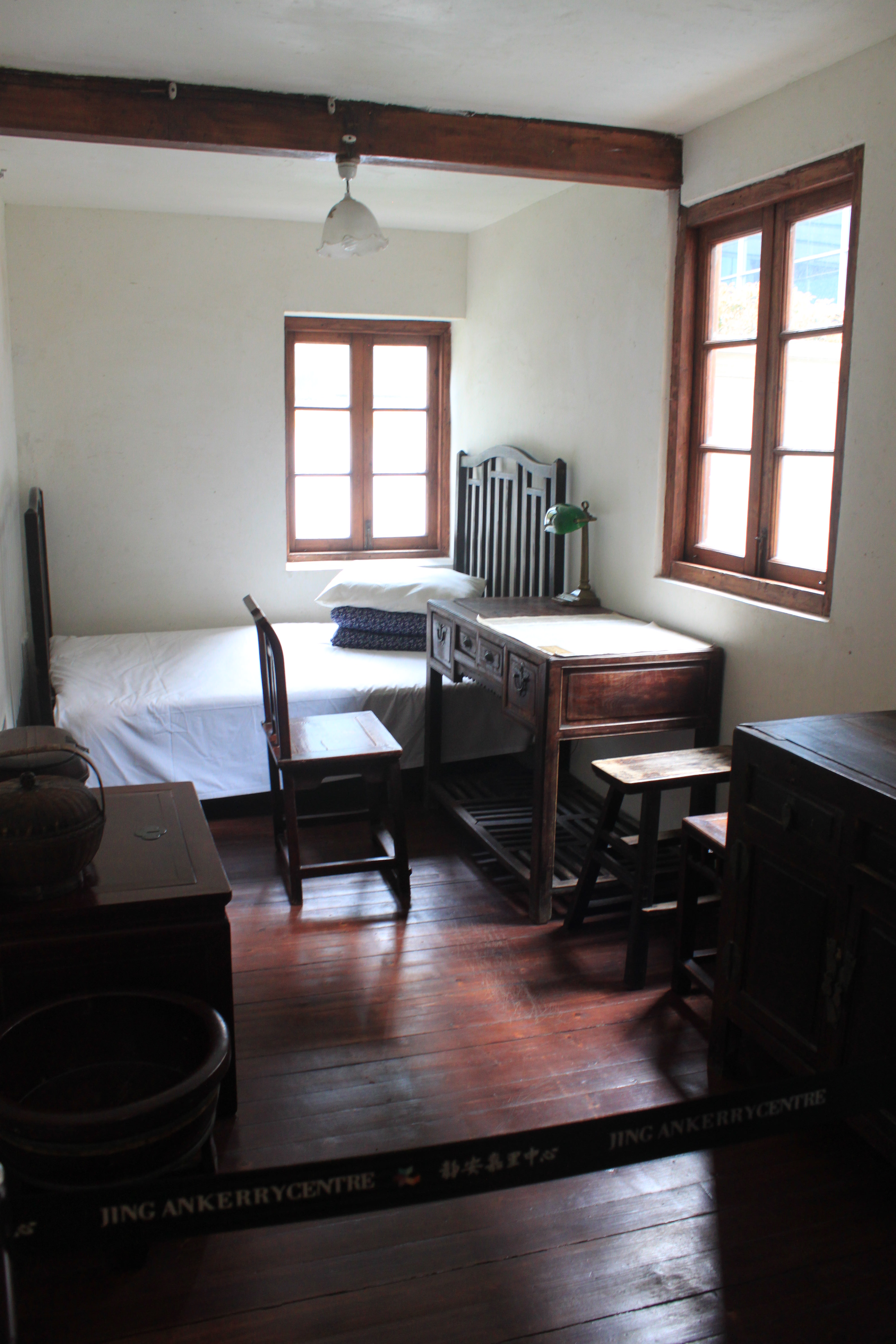
Back Bedroom
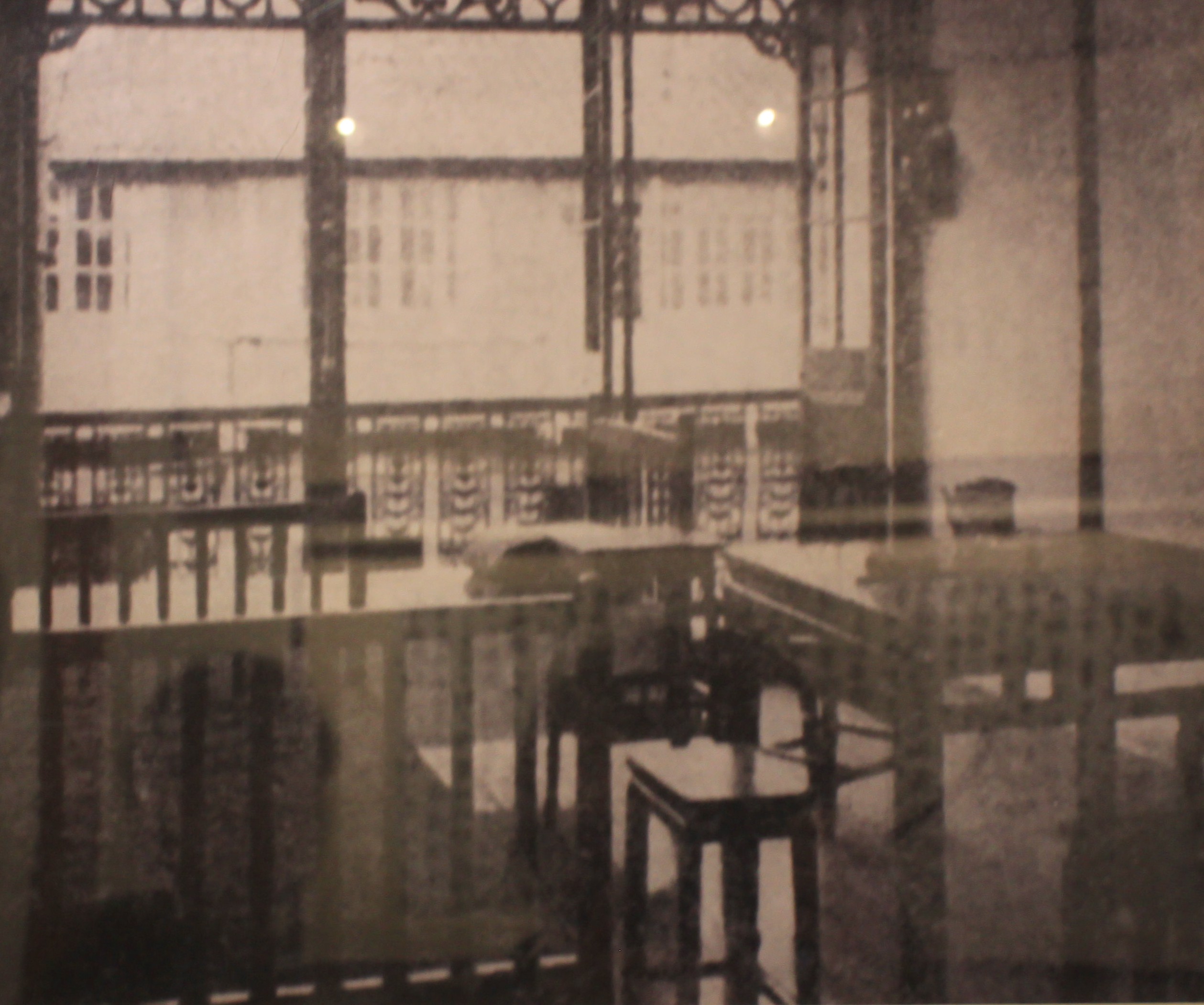
Mao’s front room as it was
The house had a small back bedroom and in the front room a short slide show about some aspects of his life. The slide show tells me that Mao arrived in Shanghai on 12th March, 1919 “to say farewell to his fellow students going to France” and in May, June 1920 he decided to stay in Shanghai on a work study programme. The group of 196 work study students actually left for France on 7 November 1920.
“August 1920 China’s Early Communist Organisation officially founded by Chen in Shanghai. Earlier in July, Chen commissioned Mao to go back and establish the formation of that organization in Changsha. When Mao returned to Shanghai to attend the 1st Congress of the communist Party he served as the elected Changsha’s Early Communist Organization Representative.”
The group of houses in the Shikumen terrace are nowadays completely isolated from other houses of similar type – all the others having been knocked down (one of the men who works with Richard lived in one as his childhood home) and replaced by high rise buildings. Other units within the terrace house art galleries such as Mao Space.
Shanghai is considered as the birthplace of China’s modern industry and therefore it had the most concentrated urban working class. I think Marx argued that it was only from these ranks that revolution could be started. It was on 23rd July, 1921 that Mao attended the First National Congress of the Chinese Communist Party as a minor delegate, so he was living elsewhere at this time – at The Bowen Women’s School:
Bowen Women’s School 389 Bare Road (127 Taikang Road)
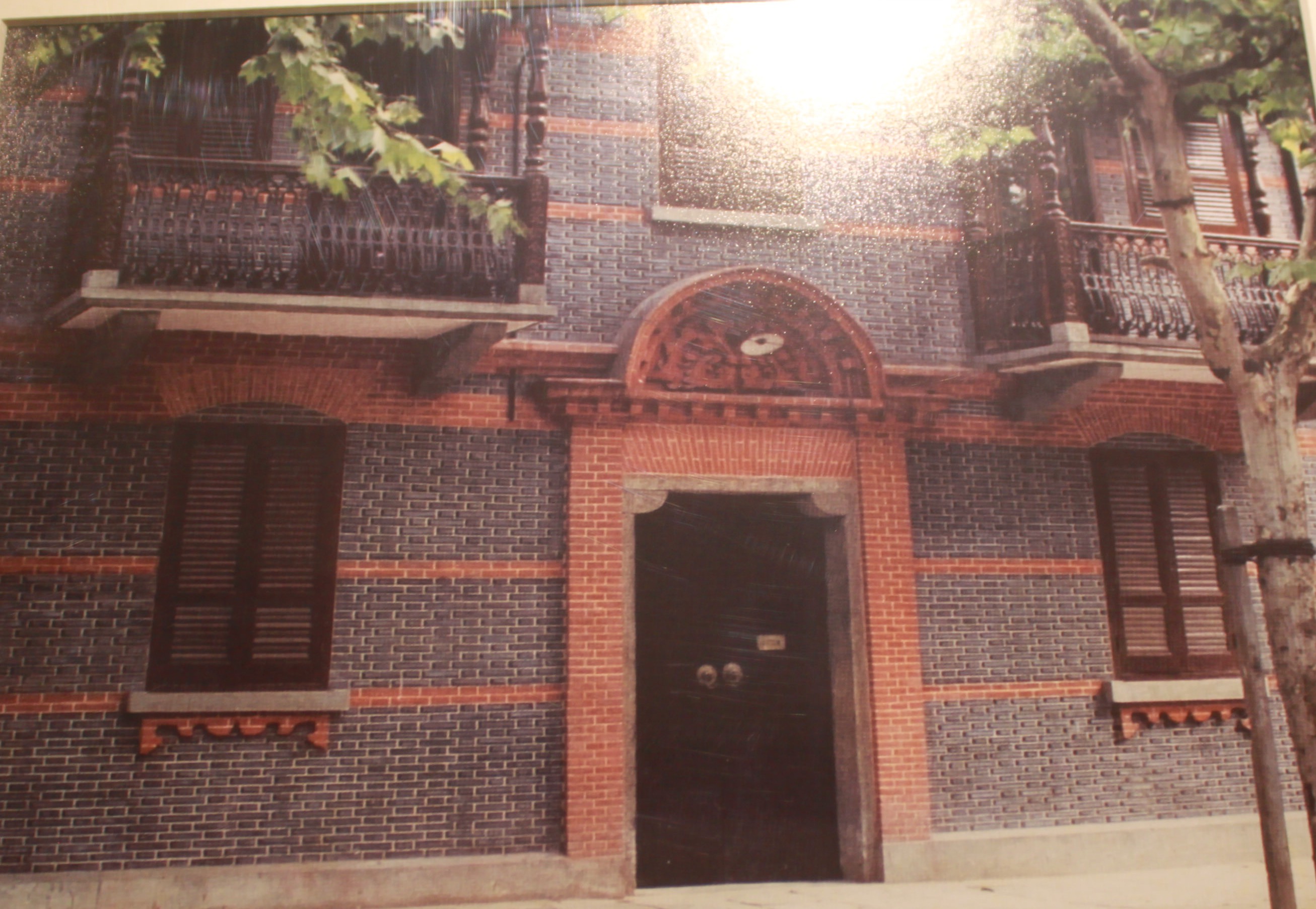
Bowen Women’s School
When Mao Zedong came to Shanghai to attend the First National Congress of the Chinese Communist Party he shared lodging with other representatives in the Bowen Women’s School at 389 Bare Road (now 127 Taikang Road) in the French Concession. (It was the school holidays!) Chen Duxiu (in absentia) was elected at this meeting as the Party’s First General Secretary. It has been said that up until this time the Chinese Communists were a number of different reactionaries from all over the country but the Comintern representative Grigori Naumovich Voitinsky, brought all the various groups together.

 Pearls From The Orient