
One of the tasks I have set myself to do whilst I am in China is to learn how to play Mahjong. My daughter plays, as did my mother and mother-in-law, but somehow I never learned. It will be good to know what I’m doing, not only to play with her, but because there are some Mahjong aficionados that live back home in Fordwich. Maybe by the time I go back I shall be able to play the game with Roger and Janet’s father.
It has been described to me as being a bit like the card game rummy although it is played with dominoes-like tiles rather than cards. I first came across mention of it whilst playing the role of Bunty in a school production of Noel Coward’s The Vortex, which deals with promiscuity, repressed homosexuality and cocaine addiction among the upper classes, a bit risqué for a 1970s girls’ school. In Hong Kong you could here the clattering of tiles, known in Chinese as the twittering of the sparrows, as the tiles were shuffled on the tables all over the Chinese residential areas in the 1980s. Mahjong itself means the game of the sparrows. It seemed as if every tower block and every apartment and every home was hosting a game. I’ve come across the odd table of players on the pavements in Shanghai but not nearly as often as in the Hong Kong of my youth. There serious money was gambled away on the game. Here I understand gambling on the game is outlawed, but I have still seen money changing hands.
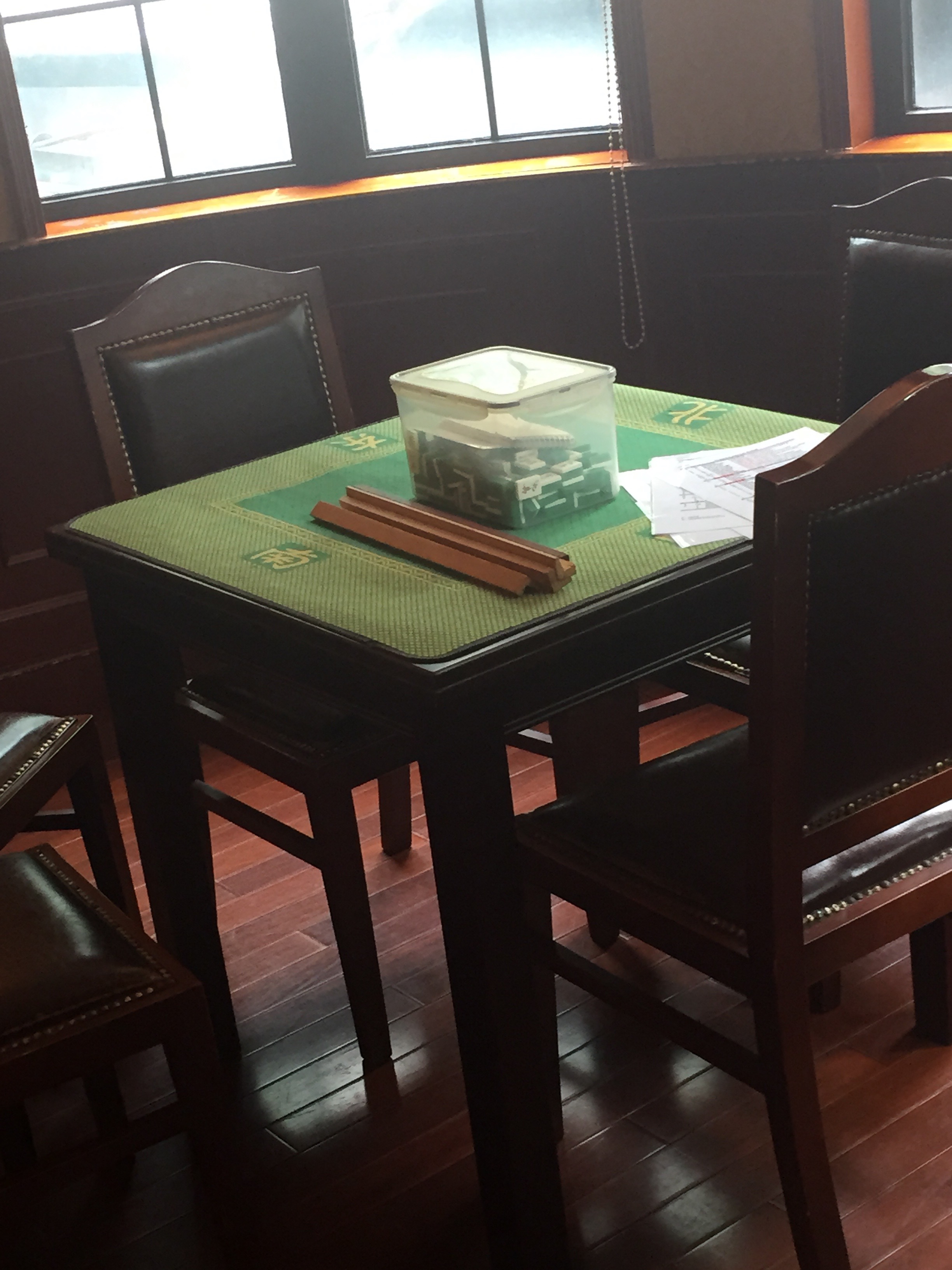
Tables Ready for Play
So since the end of August I have been taking myself off on Monday afternoons to the Park Tavern on Hengshan Lu where the Brits Abroad Mahjong group set up as many playing tables as are needed. There is always a Beginners’ Table so any member of Brits Abroad in Shanghai can just turn up and play no matter their skill level. You can play the game with 2 to 5 people per table. The Shanghai Expats Association also play weekly, as do the Australians, I understand, but they apparently are not very British about it all and take it much more seriously than we do. I have heard money even changes hand. The rules vary from club to club, town to town, country to country, so you have to have your wits about you if you move from one club to another.
Some of us turn up at 12.30pm so that we can enjoy lunch together at the pub before moving to the upstairs bar, where we hand over our small payment for drinks and room hire and begin rolling out the special green baize mats on top of the square bar tables.

Karen our teacher
The first couple of times I went I was taught by a very patient American lady called Karen who is also a school teacher. We started a very interesting discussion about the Chinese education system and the type of games that English teachers get their Chinese pupils to play to make them think independently and creatively. It was a fascinating if unfinished conversation.
We played open hands to start off with, so that we beginners could all see what everyone had and she could help us make the right decisions on our next move. The tiles are made up of three suits (numbered from 1 to 9) – bamboo, circles and characters. In addition there are the wind (East, South, West and North) and the dragon (Red, Green
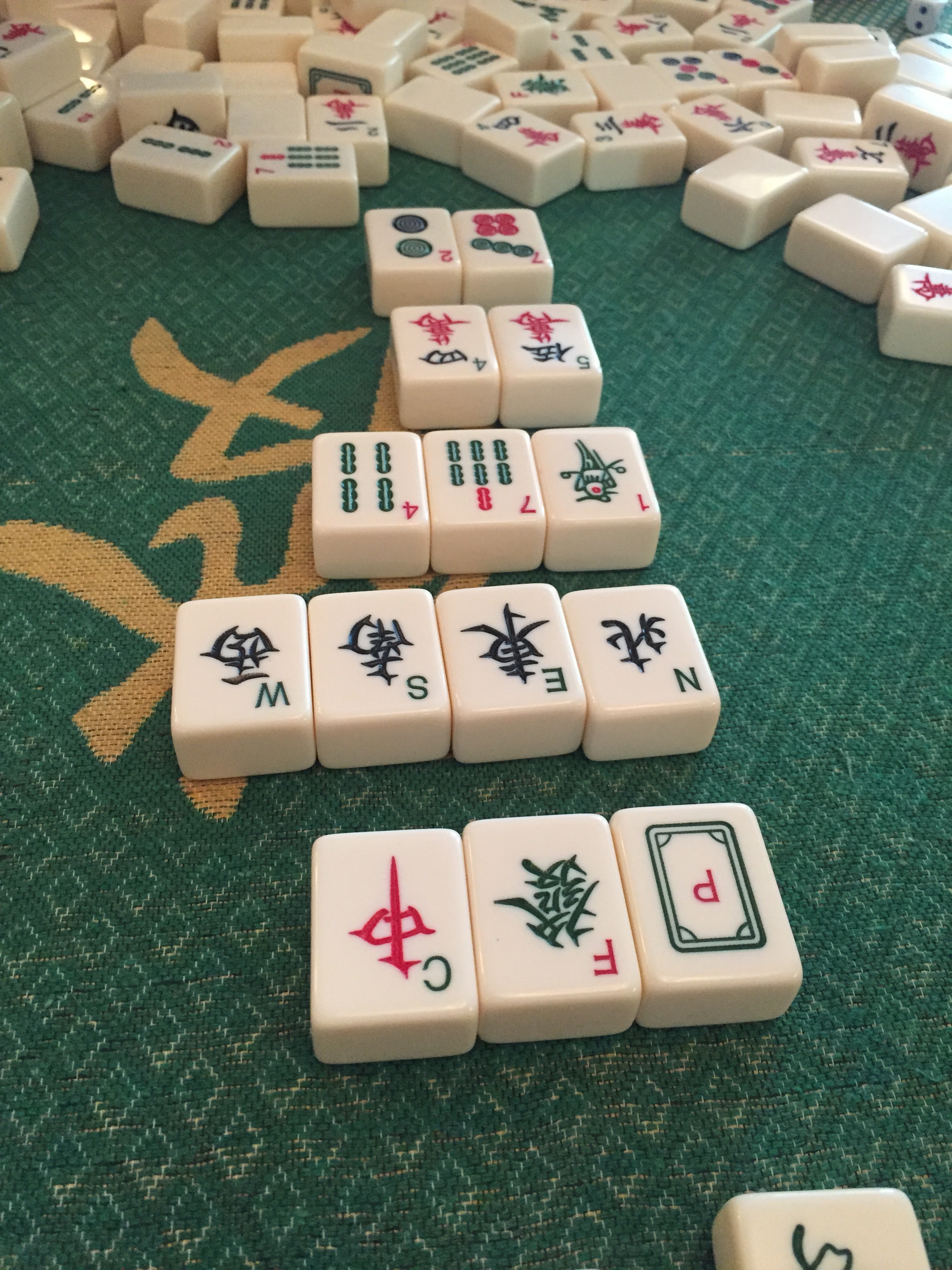
From the Top: Circles, Characters, Bamboo, Winds and Dragons Tiles
and White) tiles. All of these tiles, the suits, the winds and the dragons are duplicated another 3 times.

Dragons from L to R:
White, Green, Red
In addition to all these tiles are the flowers and seasons:

Flowers and Seasons Tiles
The Flowers:
- Plum
- Orchid (Lily)
- Chrysanthemum
- Bamboo
The Seasons:
- Spring
- Summer
- Autumn
- Winter
These all have a similar function
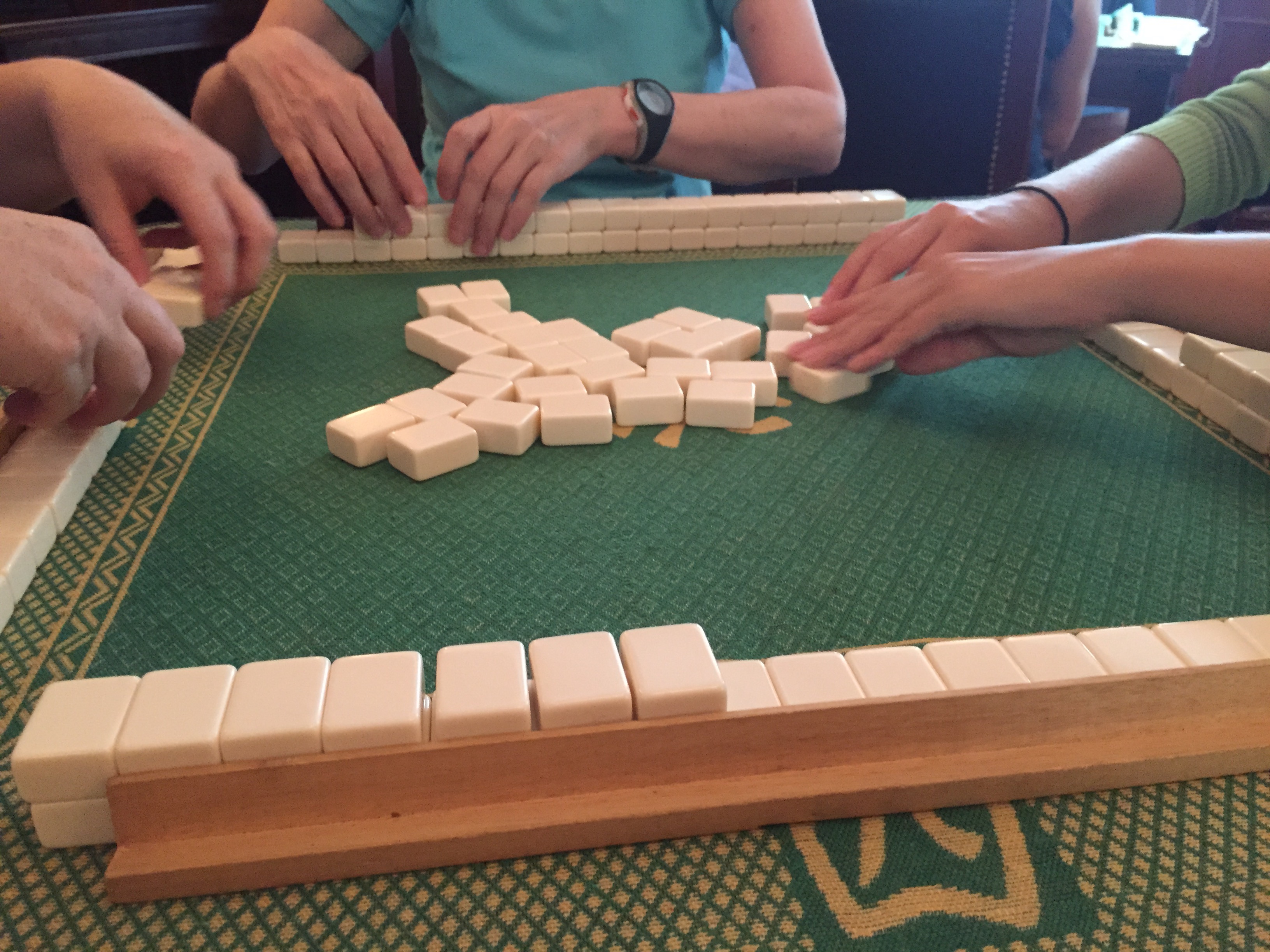
Building the Wall
to a “Go pass Go” card in Monopoly. None of these special tiles are duplicated. Sometimes there are also extra plain tiles and jokers as well, but a full set is made up of 144 tiles.
The game is normally for 4 players, although as I have said it can be played with 2 up to 5 players.
The game is started with all the tiles being shuffled face down in the centre (the twittering of the sparrows) and then
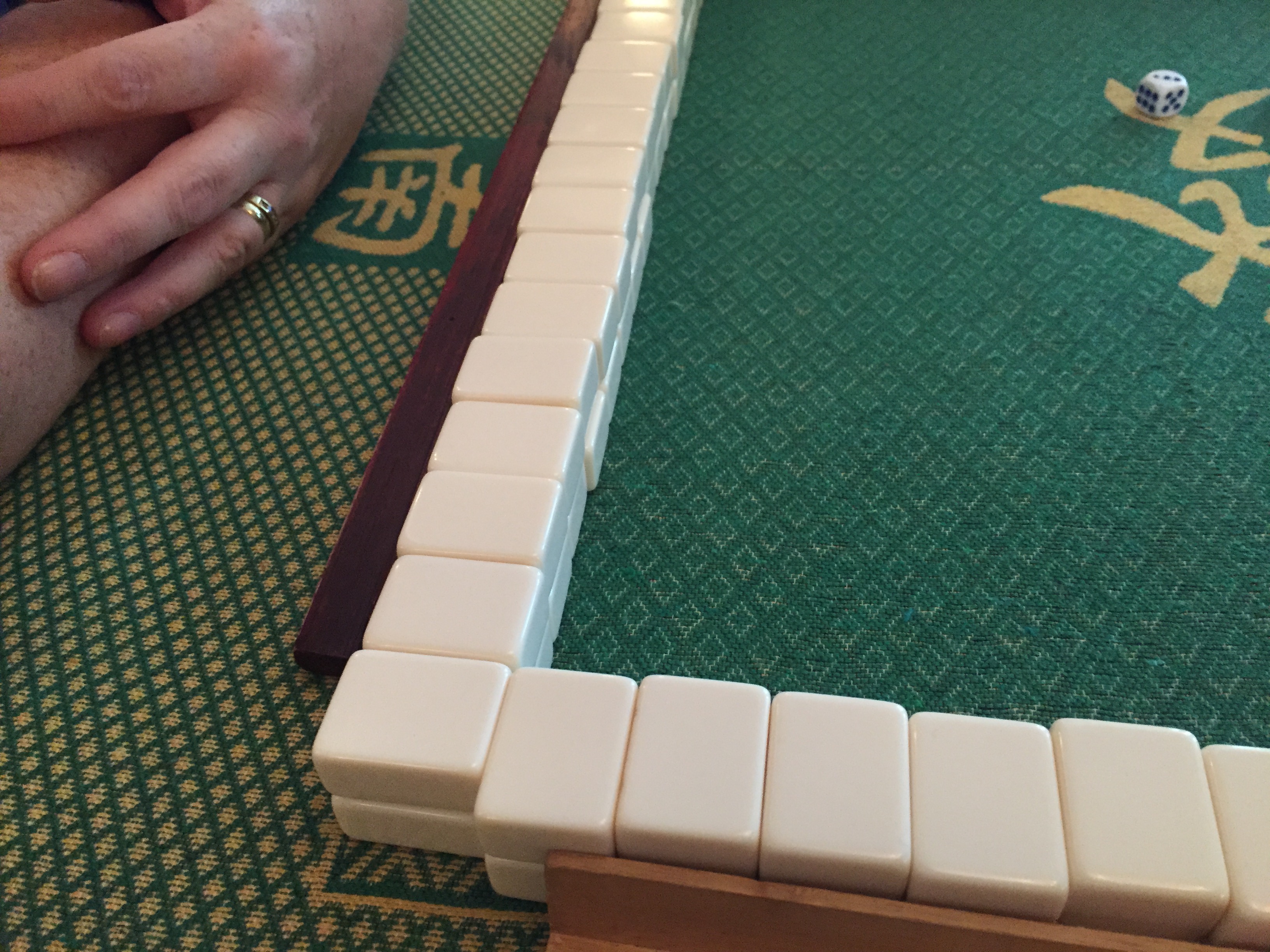
No gaps are left
from these tiles each player builds a wall 2 tiles high and 18 long which are then pushed together to form the box. The wall symbolises the Great Wall of China, and the ends of the walls must touch so that no evil spirits or dragons can enter.
Two dice are thrown to determine which player is the East Wind. Unlike in the UK and probably the rest of the Western World where our natural tendency is to start at the North and play clockwise, here

Distributing the tiles
everything starts in the East and goes anti-clockwise. (I’ve wonder whether this has anything to do with geography, or the sun – the position of China to its known world cf the position of the old world relative to its). Another throw of the dice determines where the player East Wind will break the Wall and then collect the players’ tiles distributing 13 tiles to each player who stores them on their rack. (East wind gets an extra tile which is then discarded into the centre at the start of play and has a different coloured rack to denote that they are indeed, East Wind.) The untouched end of the wall is known as the Kong Box (denoted by a stack of tiles) and is the source of extra tiles when for example someone uncovers a season or flower tile.

A game under way.
The aim of the basic game is to operate in one of the three suits and to build up identical tiles in that suit to collect 3 tiles the same (a pung), or all 4 tiles the same (a kong). It is not to collect a run of tiles of the same suit, which is what we westerners tend to try and do. You may do this – a run of three tiles in the same suit is a chow – but it doesn’t score any points. Tiles are picked up from the wall and discarded face up into the centre as players try to improve their hands towards achieving Mahjong. The aim is to get 4 sets and a pair of identical tiles at which point the player calls out Mahjong.
Things are little more complicated than this, of course. A player can pick up the last discarded tile to create a pung or kong, but these must then be revealed which shows the other players which suit the player is working in. With competent players things move very fast and mistakes are easily made.
Mahjong itself is not the end in itself. It gives the player some points, but it is the quality of each player’s hand that determines the actual scoring in the game. For example if you collect the wind associated with your position of play (you are the player east wind and have east wind tiles) you get more points. Tiles numbered 1 and 9, and the winds and dragons score more points than the rest of a suit. If you have the flower or season of your wind you get more points. If you get all four flowers you have a bouquet, and you guessed it, more points. If you don’t reveal your pungs or kongs you get more points.
And many of these features are multiplying factors in the overall scoring, not just additional as a Westerner would expect, so even though you aren’t the one who calls Mahjong you may still win the round.
And there are still further complications, which I’m still trying to learn. (I may never get there!) There are 78 special hands under the British rules of the game that can allow you to call out Mahjong. They have splendid names like Imperial Jade, Chop Suey and Red Lantern. All are higher scoring than the ordinary Mahjong, but trying to achieve any of them will negate your ability to reach an ordinary simple Mahjong. So the less likely you are to be able to achieve one of these special hands the greater the increase in the risk, but the greater the reward.
For example the hand Unique Wonder would be one of each wind, ESWN, one of each dragon GRW, 1s and 9s of each suit and any tile paired. Which is so far removed from the ordinary Mahjong and statistically so hard to achieve that it is a particularly high scoring hand.
It makes a wonderful arena for gambling if you are so inclined and it has made some people in times gone by and broken many, many more. Mainland Chinese have been banned from gambling, but as the visitors to Macau and Hong Kong demonstrate at their respective casinos or the race tracks, they absolutely love it if they are given the chance.
So there you have it Mahjong – The Game of The Sparrows.
Anyone wanting to learn to play Mahjong by The British rules can teach themselves with the help of this useful website.

 Pearls From The Orient