
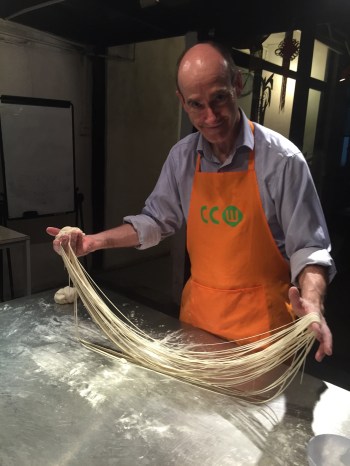
 Not long after Rozy arrived in Shanghai we went together as a family, along with a work-colleague of Richard’s, Lucinda and Jenny her visiting daughter, to an evening session at the Chinese Cooking Workshop to learn to make La Mien hand-pulled noodles. (Literally, lā, (拉) means to pull or stretch, while miàn (simplified: 面/traditional: 麵) means noodle)
These Chinese noodles are made by working a simple flour, salt and water dough by kneading it for 10 minutes and then adding a watery mixture of the herb fleabane, which is pummelled with the knuckles into the dough. This is then


kneaded until the dough is as smooth as a “baby’s bottom.” The fleabane works into the gluten structure of the flour making it glistening and shiny and very elastic. Long lengths of the dough are stretched out and twisted back on themselves, helped by banging the dough on the table as you go. (I couldn’t quite manage this bit.) Repeated a couple of times this helps to make the dough into an evenly formed sausage shape.
This sausage length is then stretched into long lengths of dough that are successively stretched by hand under their own weight and folded and stretched to make the thin strands of the noodles. The greater the number of stretches and foldings, the thinner the noodles that are produced. To create good quality even thin noodles requires great skill, but it is not beyond the amateur to produce good enough noodles during the first lesson, as long as their is an expert on hand to give help and guidance.
When ready to pull to create the noodles, the evenly cylindrical workable sausage of dough has each end removed and the dough pulled-out to an arm span’s length. The two ends of the dough are then placed either side of the middle finger of the right hand held gently in place by the forefinger and the ring finger. The dough is kept supported on the table and the dough is not squeezed by the fingers, otherwise the dough will be weakened at these points which will later cause it to break.


A forefinger placed in the loop in the middle of the stretched noodles starts stretching the dough once again. Now these two strands of dough are stretched out again, as steadily as possible, and once a loop is created again, the middle of the loop is hung over the middle finger of the right hand. A critical step now is to pull the ends of the dough in your right hand up into the palm of your hand, as these will have got thin in the process and will be the point of weakness where the noodles will break in the future, so by lifting them into your palm you will eliminate these weak points. And each time the strands are stretched, the ends are then brought together in the palm of one hand in an ever increasing ball of dough. These end dough pieces must be kept out of the way from subsequent stretching as their gluten molecules are no longer aligned with those in the stretched strands.Repeat again with these 4 strands and then 8 and so on.
The process is repeated until the noodles are thin enough, each time doubling the number of noodles whilst decreasing their thickness, but not so thin that they start to fall apart. Eventually a vertical palm of the hand, rather than just a finger, is used to keep the middle of the noodle loop separated.
Practising to get it right, in case from the above, you thought it looked or sounded easy:


The first description of making of these noodles was recorded by Song Xu in 1504. The stretching and folding aligns the gluten in the dough, whilst the initial kneading warms up the dough for stretching it and is worked by stretching and then allowing it to twist around itself.
Sometimes the noodles are banged in flour on the table immediately after a stretch to help keep them separate. This is the Lanzhou style of noodle making, where there is no twisting or waving of the dough, but in the Hai Di Lao Hot Pot restaurant we have seen the Beijing style where the dough is stretched by waving the arms about and flicking it out over the customers’ heads to increase the length of the noodles.
The noodles are used in a beef or mutton-flavoured broth called tāngmiàn (simplified Chinese: 汤面; traditional Chinese: 湯麵; pinyin: Tāngmiàn literally ‘soup noodles’), but they can also be stir-fried and smothered with a sauce, known as chǎomiàn (simplified Chinese: 炒面; traditional Chinese: 炒麵; pinyin: Chǎomiàn, literally meaning ‘fried noodles.’ which led to the similar Chinese dish served in the West of chow mien.
Many La Mien restaurants are run by Hui ethnic families from Northwestern China, who serve halal food and therefore no pork. Uzbek families serve thicker noodles in the same fashion and where they are known as läghmän (leghmen) (لەغمەن, лӓғмӓн) derived from the Chinese word lamia, there being no Turkic words beginning with the letter L.
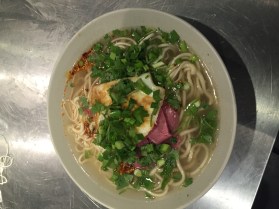 The noodles, once pulled, are immediately added to the broth and heated through for a 7 to 8 seconds and then served, together with 30g of sliced beef, 50g chopped coriander and 5g of finely diced garlic and a fried egg.
Finally, at the end of our lesson, we all tucked into our own dish of hand pulled noodles.


 Pearls From The Orient