Gubei’s Pyongyang Restaurant

 As I think I have mentioned before we live in a predominantly Japanese/ Taiwanese/Korean area of Shanghai, with our own Japanese Department Store, Takashimaya, above our metro station and with a number of smaller shops and restaurants in the area selling country specific food.  We can easily buy Korean kimchi at a number of corner shops around here, sushi elsewhere, and probably, although I’ve not sought it out, Taiwanese Bubble Tea.  We can eat Japanese bar food, or go to one of several Korean or Japanese Barbecue restaurants all within easy walking distance.
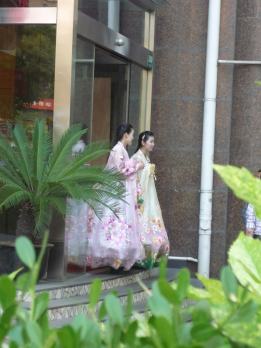
p1070774Also within easy walking distance is one of a number of North Korean Pyongyang Restaurants in Shanghai. Ours, PingRang GaoLi Restaurant as been a lure ever since we moved into our apartment, as early in the evening ladies in over-the-top traditional Korean dress stand at the ground floor entrance trying to entice customers into the place, whilst never actually leaving its threshold.  I have been a couple of times, once with a friend of my daughter’s who is currently teaching English at a school in Seoul, South Korea and last week with a group of people from the UK’s Pret à Manger business who have a couple of stores here in Shanghai.

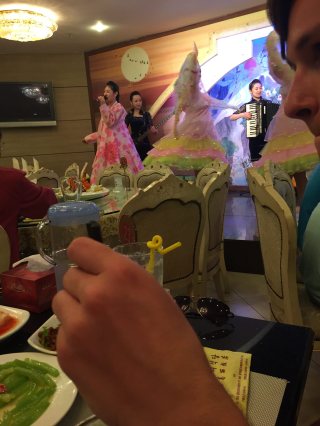
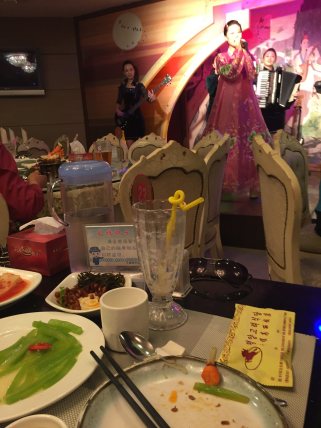
If you go early enough in the evening  – we are talking 6pm here – these ladies will show you upstairs to the p1070873second floor (1st floor in UK speak) restaurant and to a whole surreal experience that mixes average quality Korean food with a Butlin’s-style performance  – the waitresses themselves become the performers at 7pm, once they have served the food and made a quick change.
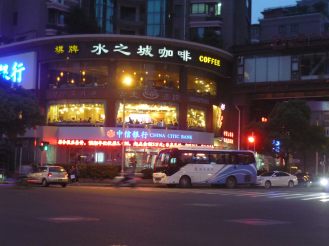
The food was generally unremarkable – you don’t go to the place for the food, more for the experience.

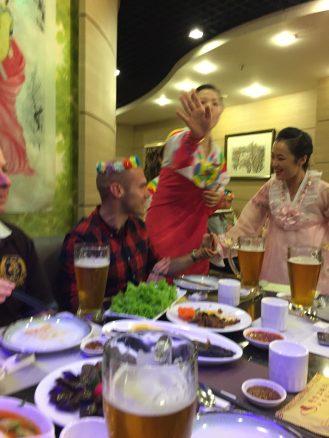
img_9312img_9314At 7pm a number of the waitress disappear and change into a mixture of traditional Korean costumes and western-style velvet dresses and sing North Korean popular songs, and perform a number of acts including what looked like Irish dancing with some of the girls playing bass guitar, keyboard and a set of drums.

Towards the end of the show unsuspecting customers have plastic flower garlands placed on their heads which marks them out later on for being collected up into a North Korean version of the conga whilst the singers sing a song to their Great Leader.

The first time I went, was with James (and his brother Peter who had met up with him to tour China) which made the whole experience particularly interesting for me. James, speaking some Korean, was able to talk to and translate for the waitresses.  He was careful to use North Korean terminology all the time that he was speaking to them, one in particular kept coming back to talk and they were particularly chatty with him.  They liked the fact that we came from England but would not engage in anything about themselves or what they thought of Shanghai, or even Gubei Lu.
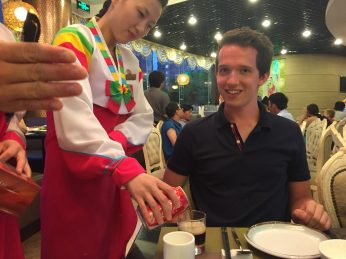
img_9300All was going swimmingly until two issues disrupted things.  First of all they do not like their customers taking photos, or videos.  For James this was a shame as he was using a video camera to document his China trip for his English students back home in Korea and I, as you know, like to document everything that I have done since arriving in Shanghai.  They could tolerate us taking photos of the food, but whenever a camera was pointed at a waitress someone hovering behind always said “No photos.  No Photos” over our shoulders.  We did what we could and managed to capture pictures of some of the waitresses, even whilst they were performing, but it was
img_1793

That No Photo Moment

difficult.  They could tolerate pictures of customers up on the stage after the performance, but not during it.  Why does a North Korean restaurant not want you to take any pictures of any of the staff?  What have they got to hide?  It was interesting that to the outside world the whole place was run completely run by women.  There was not a man in sight, not at the front desk, not serving, not performing.  There was no male front of house at all.  Which is odd from a devoutly Confucian country – one that espouses the importance of a male heir – so they must be somewhere behind the scenes, pulling the strings.

The second issue was that during one of his conversations with the waitress towards the end of our meal James let slip that he lived in Seoul.  Everything changed after that.  The waitresses clammed up and kept their distance.  Westerners were fine to chat to, especially if they speak Korean.  Ones that lived south of Korea’s DMZ (Demilitarised Zone), definitely not.

These restaurants across Asia are run by the North Korean government, to earn foreign currency.  The waitresses have a fixed smile on their faces and tend to all have similar features. It has been reported that those that work in any one of these restaurants do not know of, or know very little of, other restaurants in the same chain, even if they are in Shanghai.  The women reportedly all come from strong party families from the capital Pyongyang, where for example there is electricity at night, so having it available here in Shanghai in the evenings would not cause too many questions, and as they all come from good North Korean families the possibility of defection or challenging the system is low. In addition their social circle is apparently confined to those who also work in their restaurant.

No photos, fixed smiles, lack of openness, fear of Seoul connections, cloned look…….It all had the feeling of a North Korean version of The Stepford Wives.
Posted in Changning, Restaurant | Tagged , , , | Leave a comment

La Mien Hand-Pulled Noodles

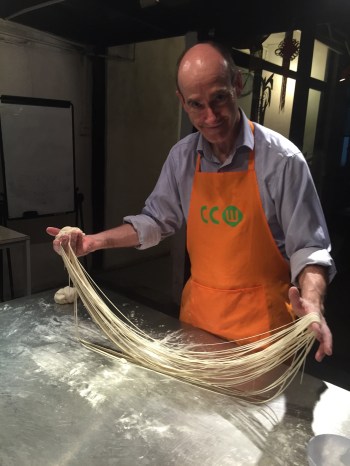
img_7925Not long after Rozy arrived in Shanghai we went together as a family, along with a work-colleague of Richard’s, Lucinda and Jenny her visiting daughter, to an evening session at the Chinese Cooking Workshop to learn to make La Mien hand-pulled noodles. (Literally, lā, (拉) means to pull or stretch, while miàn (simplified: 面/traditional: 麵) means noodle)


These Chinese noodles are made by working a simple flour, salt and water dough by kneading it for 10 minutes and then adding a watery mixture of the herb fleabane, which is pummelled with the knuckles into the dough. This is then


kneaded until the dough is as smooth as a “baby’s bottom.”  The fleabane works into the gluten structure of the flour making it glistening and shiny and very elastic. Long lengths of the dough are stretched out and twisted back on themselves, helped by banging the dough on the table as you go. (I couldn’t quite manage this bit.)  Repeated a couple of times this helps to make the dough into an evenly formed sausage shape.

This sausage length is then stretched into long lengths of dough that are successively stretched by hand under their own weight and folded and stretched to make the thin strands of the noodles. The greater the number of stretches and foldings, the thinner the noodles that are produced.  To create good quality even thin noodles requires great skill, but it is not beyond the amateur to produce good enough noodles during the first lesson, as long as their is an expert on hand to give help and guidance.

When ready to pull to create the noodles, the evenly cylindrical workable sausage of dough has each end removed and the dough pulled-out to an arm span’s length.  The two ends of the dough are then placed either side of the middle finger of the right hand held gently in place  by the forefinger and the ring finger. The dough is kept supported on the table and the dough is not squeezed by the fingers, otherwise the dough will be weakened at these points which will later cause it to break.


A forefinger placed in the loop in the middle of the stretched noodles starts stretching the dough once again. Now these two strands of dough are stretched out again, as steadily as possible, and once a loop is created again, the middle of the loop is hung over the middle finger of the right hand.  A critical step now is to pull the ends of the dough in your right hand up into the palm of your hand, as these will have got thin in the process and will be the point of weakness where the noodles will break in the future, so by lifting them into your palm you will eliminate these weak points.  And each time the strands are stretched, the ends are then brought together in the palm of one hand in an ever increasing ball of dough. These end dough pieces must be kept out of the way from subsequent stretching as their gluten molecules are no longer aligned with those  in the stretched strands.Repeat again with these 4 strands and then 8 and so on.

The process is repeated until the noodles are thin enough, each time doubling the number of noodles whilst decreasing their thickness, but not so thin that they start to fall apart.  Eventually a vertical palm of the hand, rather than just a finger, is used to keep the middle of the noodle loop separated.

Practising to get it right, in case from the above, you thought it looked or sounded easy:

The first description of making of these noodles was recorded by Song Xu in 1504.  The stretching and folding aligns the gluten in the dough, whilst the initial kneading warms up the dough for stretching it and is worked by stretching and then allowing it to twist around itself.

Sometimes the noodles are banged in flour on the table immediately after a stretch to help keep them separate. This is the Lanzhou style of noodle making, where there is no twisting or waving of the dough, but in the Hai Di Lao Hot Pot restaurant we have seen the Beijing style where the dough is stretched by waving the arms about and flicking it out over the customers’ heads to increase the length of the noodles.

The noodles are used in a beef or mutton-flavoured broth called tāngmiàn (simplified Chinese: 汤面; traditional Chinese: 湯麵; pinyin: Tāngmiàn literally ‘soup noodles’), but they can also be stir-fried and smothered with a sauce, known as chǎomiàn (simplified Chinese: 炒面; traditional Chinese: 炒麵; pinyin: Chǎomiàn, literally meaning ‘fried noodles.’ which led to the similar Chinese dish served in the West of chow mien.

Many La Mien restaurants are run by Hui ethnic families from Northwestern China, who serve halal food and therefore no pork.  Uzbek families serve thicker noodles in the same fashion and where they are known as läghmän (leghmen) (لەغمەن, лӓғмӓн)  derived from the Chinese word lamia, there being no Turkic words beginning with the letter L.

 To make the beef soup for the noodles, simmer 500g beef bones and 100g of washed chicken in 5 litres of water for 2 hours. The add 50g of carrots, 30g vegetable oil, 3g of sliced spring onion, some sliced garlic and chopped parsley and simmer for a further 30 minutes.

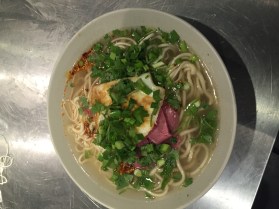
img_7947The noodles, once pulled, are immediately added to the broth and heated through for a 7 to 8 seconds and then served, together with 30g of sliced beef, 50g chopped coriander and 5g of finely diced garlic and a fried egg.

Finally, at the end of our lesson, we all tucked into our own dish of hand pulled noodles.


Posted in Cookery School, Cooking | Tagged , , , , | Leave a comment

Carrying Poles

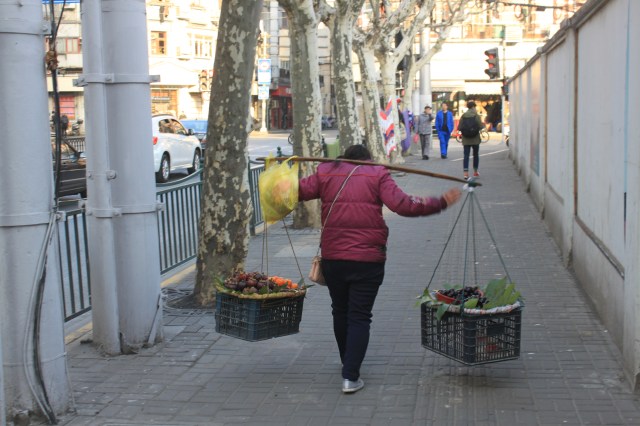
Sometime last year I posted about our trip to Amoy in Fujian Province (Amoy in Fujian; Xiamen in Mandarin) with its large round houses and some of the pictures showed women selling fruit from baskets which they carry along on a pole, just as milk-maids in the west used to carry milk pails.  These carrying poles are used throughout China.

To carry goods, the pole is either carried over one shoulder, or over the the top of the back across the shoulders.  In Fujian province the baskets are made of woven bamboo.  In modern day Shanghai, however, I have only ever seen them made from plastic crates:


modern-version-of-old-methodBut in all cases the women are using their hands to steady the pole to look after their precious cargo.

Not so, in the case below (I can’t lay claim to the ownership of this video and I’m afraid I  don’t know who to attribute it to), but in this case “look mummy no hands”:

Posted in Outside Shanghai, The Bund, Xiamen | Tagged , | Leave a comment

The 3″ Golden Lotus

This is a rather gruesome post.  If you can’t cope with human cruelty and what one women will do to her daughter in the name of beauty I suggest you skip this one.

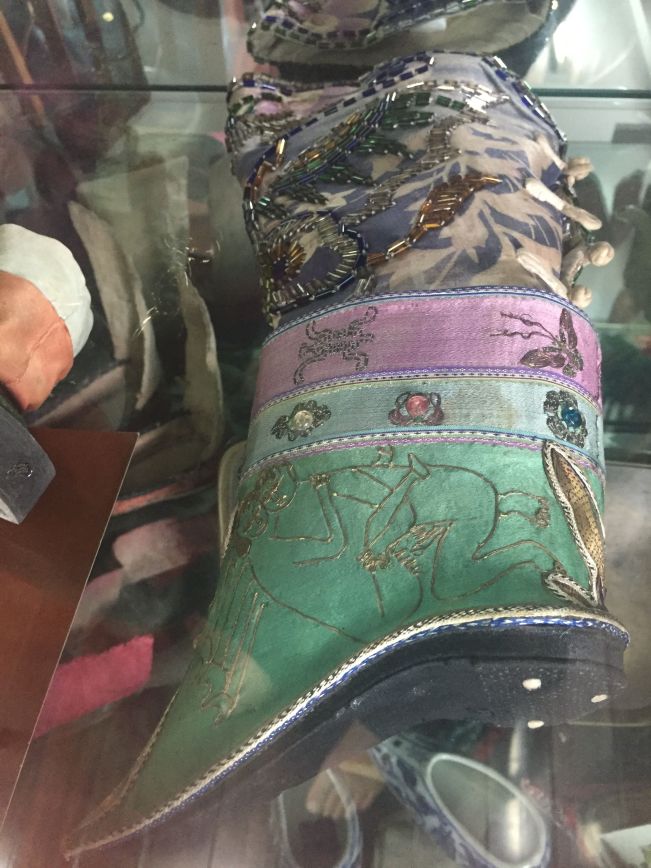
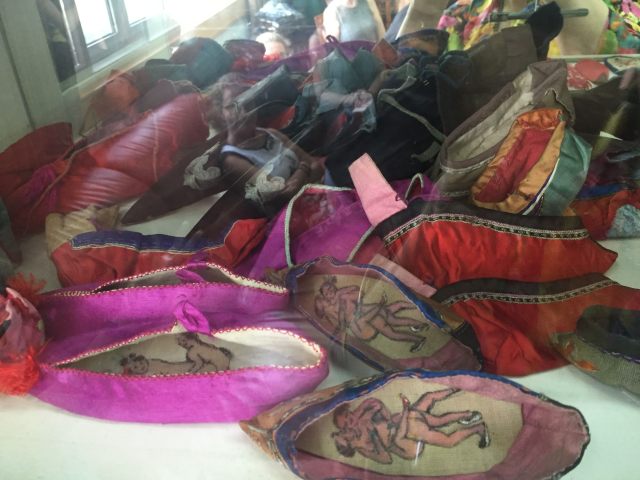
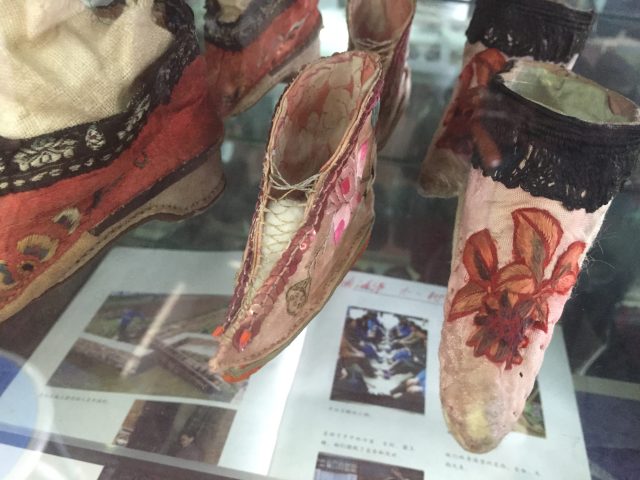
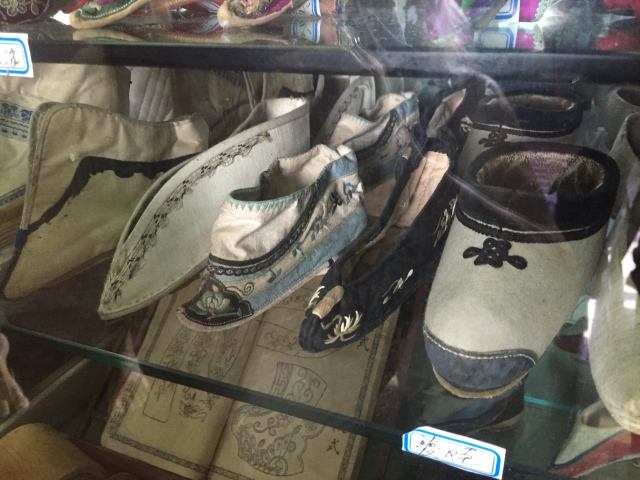
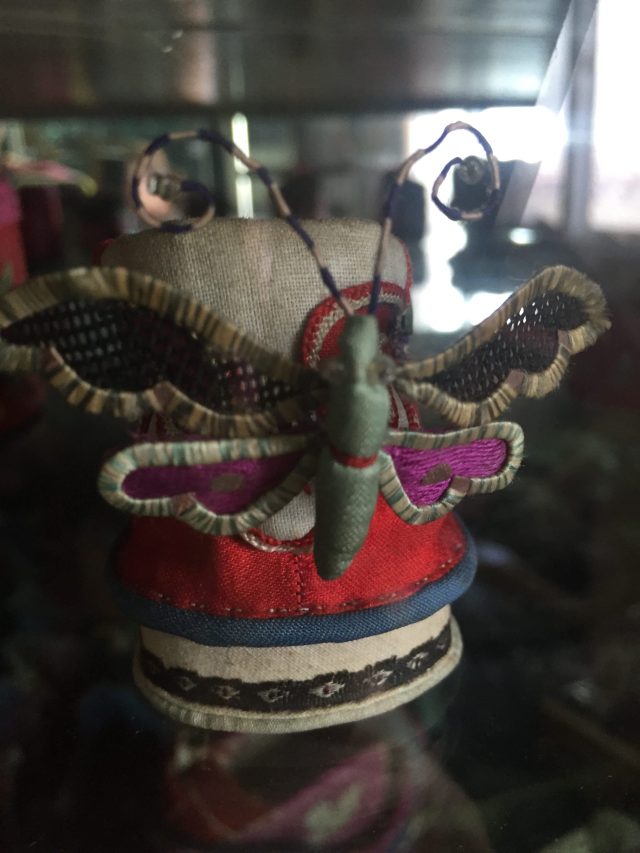
img_9487On 25th August this year I went with the Shanghai Expats Association to the Ancient Shoes Museum.  I had wanted to go ever since I had found out about the existence of this museum in Shanghai, as I had come across some tiny shoes at an Auction in the UK many years back and had been fascinated not only be the exquisite embroidery on the silk, but also by the size of them.  But as the owner of the museum Yang Shao Rong only speaks Shanghainese and no Mandarin, you have to go along to the museum with a local interpreter.  Jung Chang in Wild Swans: Three Daughters of China had written about her grandmother’s lotus feet and many others have written in novels and other books about the process of foot binding, so I was surprised how shocked some of the other women were on the visit.  Sometimes we just don’t realise how well we in Britain are informed.

The museum was housed in Mr Rong’s apartment.  The walls of his living space are completely covered in cabinets full of these shoes, because he owns 1500 of them. I understand that the local authorities are interested in doing away with his museum, the previous mayor of Shanghai hated it – when this elderly man dies his collection may well disappear – as they are embarrassed by this part of their history and wish to brush it all away for good.  Anyway the foot binding of women was practised all over China and the collection contains examples of shoes from numerous provinces.

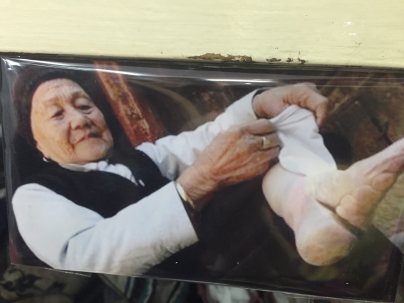
Foot binding was usually done by a girl’s mother – who of course had had the same thing done to her when she was young. As with FGM I always ask who on earth comes up with such barbaric ideas in the first place, no-one ever really knows, but there is a story that there was a beautiful concubine or princess, much favoured by the Emperor, who had exceptionally small feet and it was this need to be fashionable and in favour and marriageable that led to this practice of artificially shrinking the feet.  The practice first began just before the Song Dynasty  (Chinese: 宋朝; pinyin: Sòng cháo; 960–1279) when it became fashionable, a time when there were several other more useful inventions such as banknotes and gunpowder. Chinese women even nowadays are generally very small boned, much shorter than us westerners and usually have UK size 4 or smaller shoes.  It did involve wrapping the feet, but not until each one of the girls’ feet were broken at an angle across the metatarsals and the toes folded under the sole of the foot.  The feet were img_9491tied to a wooden stand with the feet sticking part way through the two holes in the stand and smacked with a stick (red one on right of stand) by either the girl’s mother or grandmother.  It was not optional. The toes were then bound in place under the foot’s sole.  Any woman with bound feet walked over her broken toes every step she took on her Lotus Feet for the rest of her life.  The ideal length was 3 Chinese inches long – “3” golden lotus”, the equivalent of 4″ or 10 cms shoes. (They were not called shoes).
 

img_9521

The Owner’s Mother’s Bound Foot

img_9512

Instructions For Wrapping


img_9573

Foot Binding Cloths

The fold in the feet with enclosed skin were smelly and ugly and so socks and shoes were worn all the time to hide them, even in bed.  Rich women washed their feet every day.  A Chinese insult is to call someone “like a shoe band”.

Why was it really done?  It was a severe form of hobbling. Done to keep girls and women very firmly in a box and prevent them from straying from the home.  It kept them under their parents and then their husband’s rule.

Feet were bound in different ways depending on culture, geography and family background.  Not every single girl had her feet bound.  Very, very lowly peasants didn’t, but there were women with bound feet who worked in the fields, but their feet were not made as small as their wealthier contemporaries.  Qing Dynasty feet were bound so that

img_9615

Narrow Qing 3″ lotus

they were narrow, not short, because of horse riding. Northern women, who are wheat eaters, had bigger bound feet than their southern rice-eating cousins. Northerners wore boots rather img_9496than shoes in the cold winters and  also Northern shoes had the tips pointing down, southerners the tips pointing up.
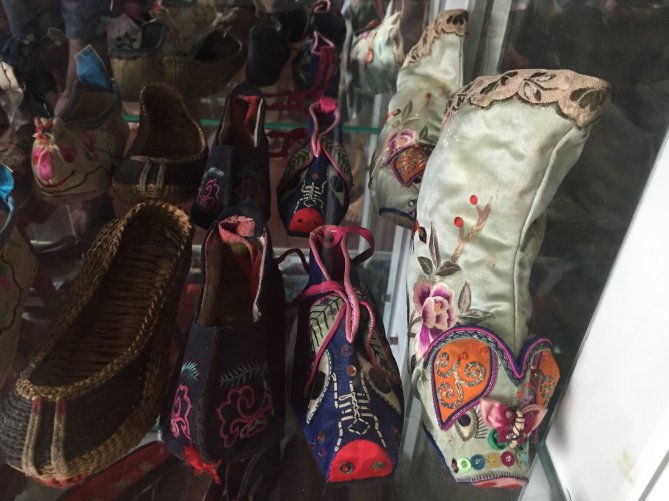
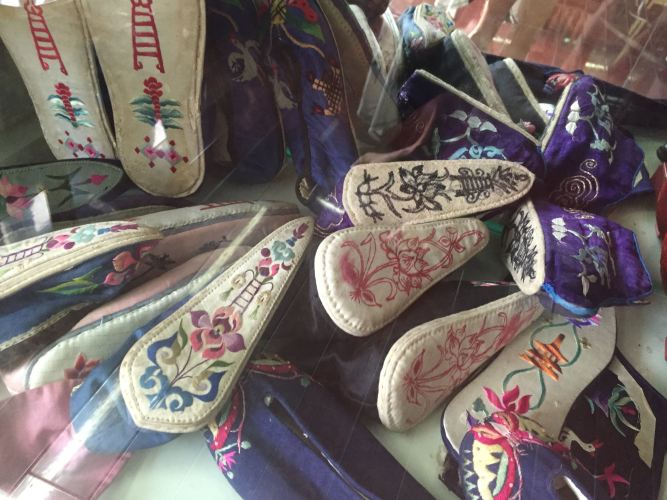
In general any girl of any standing in Chinese culture was never seen outside the home.  To go anywhere she was carried inside an enclosed palanquin.  She did not see the outside world, and the outside world did not see her.  She was allowed to sit at her front door behind a curtain that hid all but her shoes.  It was thus the size of her feet that “sold” her so the world.


img_9546

Pig Boots For A Girl


img_9549

Funeral Shoes with Red Ladder to Heaven


img_9565

Sleeping Shoes With In-built Manual for What To Do


img_9585

Really Tiny Shoes for Buddhist Temple Offerings


img_9592

Red Wedding Shoes


img_9598

Mr. Rong With His Mother’s 3″ Lotus Shoes.  No embroidery on them meant no news is good news.

img_9603

White Funeral Shoes

IMG_9604.jpg

Blocks for Embroidery

img_9607

The shimmering butterfly signified a prostitute

img_9608

Dance shoes with a powder drawer to leave patterns on the dance floor


Address:

Ao Sen Apartments in Hongqiao, 786 Hongzhong Lu
虹中路786,奥森公寓

Posted in Hongmei, Museum | Tagged , , | Leave a comment

Quilting Update

I promised many moons ago that I would keep you up to date with my quilting group.  I confess I haven’t.  We meet every Thursday at a member’s apartment and promise to do at least 5 stitches in the four hours that we are together. Often, but not always, the hostess provides lunch, otherwise you take along your own.

img_8399 img_8409

img_1195img_1198

This way we see other parts of Shanghai and other people’s homes. The friendships that are created in this group are long-lasting and spread throughout the world as the constant churn of expats in Shanghai means that people are always leaving and joining but throughout the Thursday meet-up is a constant.

img_9624The nice thing about meeting to create something is not only about the creative act itself, but also seeing and being excited by what others are producing.  It also allows for a very natural flow of conversation to which you can contribute or not as the mood takes. A panacea for introverts, in a city and a life that demands extraversion at every turn.


img_0363img_7342 We are a multi-national group. Current membership has a strong Dutch contingent ranging from professionals to complete beginners.  Knowledge is generously shared. Luckily for me the lingua franca is English, the food we are served are classic dishes from each of our countries.

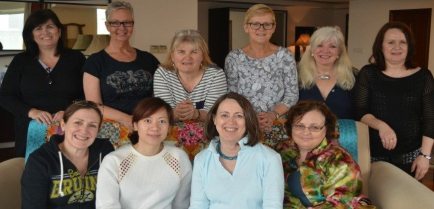
Somehow in the Spring we managed to become the subject of an articleimg_0449 by the Accuquilt company blogger, who seemed to be going round the world visiting her friends and searching out quilt groups to write about as she went.  This led to a rather bizarre afternoon that was a lot more lively than normal, verging on the surreal, but we did end up with a nice group photograph of “Jenny’s quilt group”.

img_9437Jenny from Holland had her own quilt shop for many years, but not in Shanghai, although she does support one just two blocks down Gubei Lu from our apartment.  She generously helps everyone make their quilts better, teaching the absolute beginners and giving help when asked.  She is very good, not often asking “What ARE you doing?” which is what she said to me as she watched me struggling to make my first colonial knots.  I’d looked up how to do them in a book and found instructions on line and then tried to reverse their right-handed instructions to my left-handed way of doing things, but was failing miserably.  I was doing it in a very cack-handed way.  She patiently sat opposite me and plugged away at it with me until I had managed to mirror her right-handed actions to those in my left-hand.

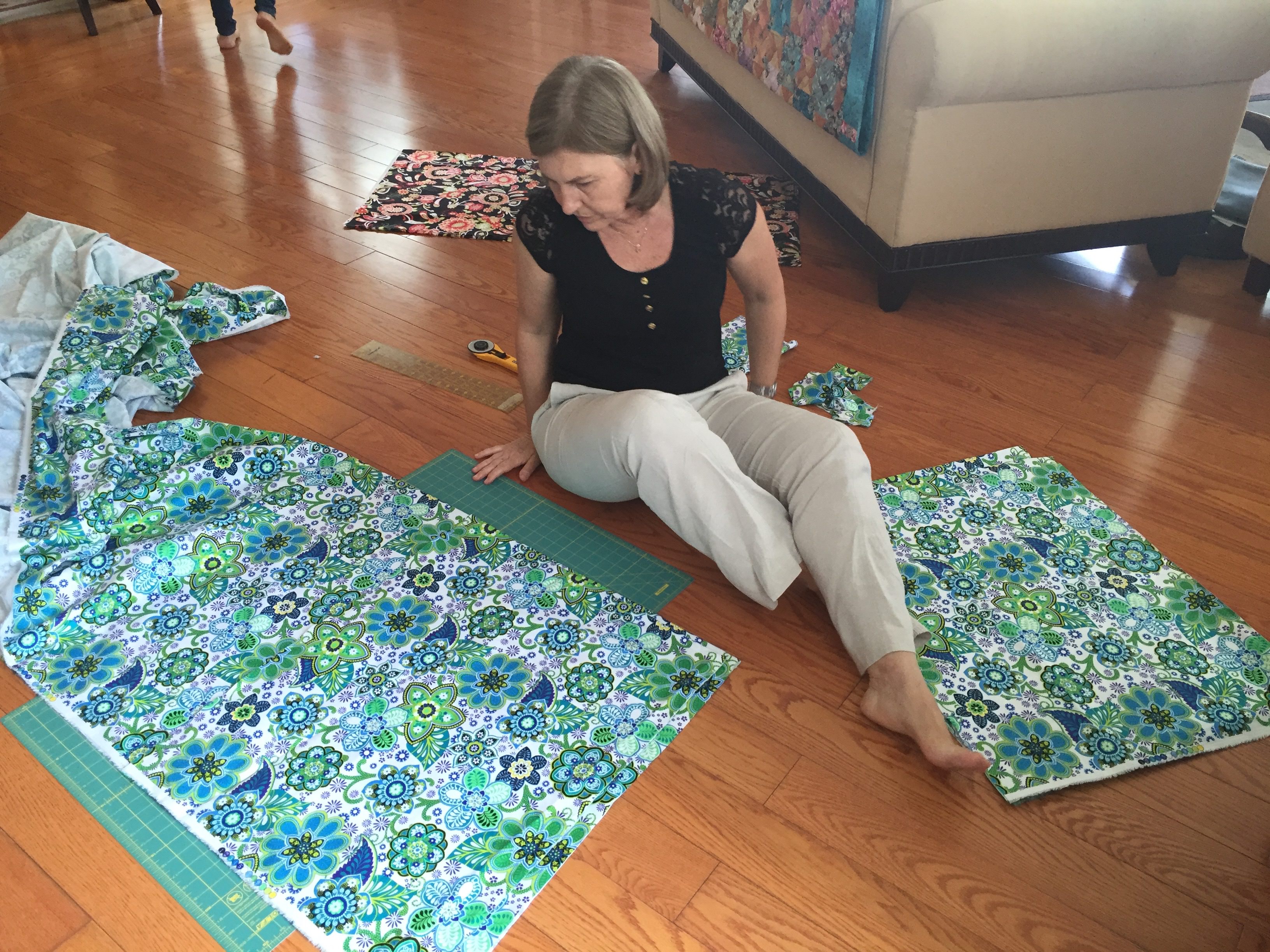
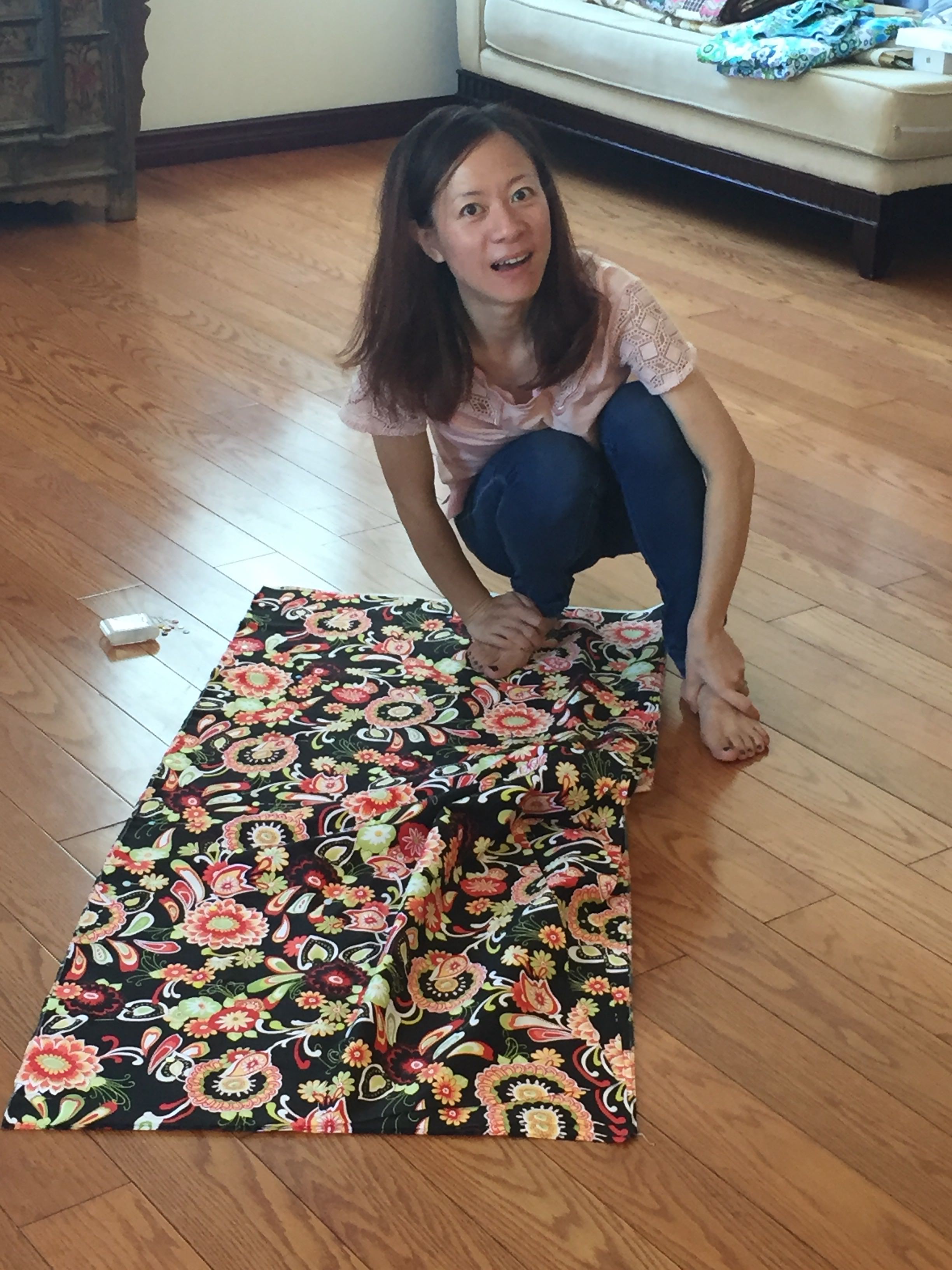
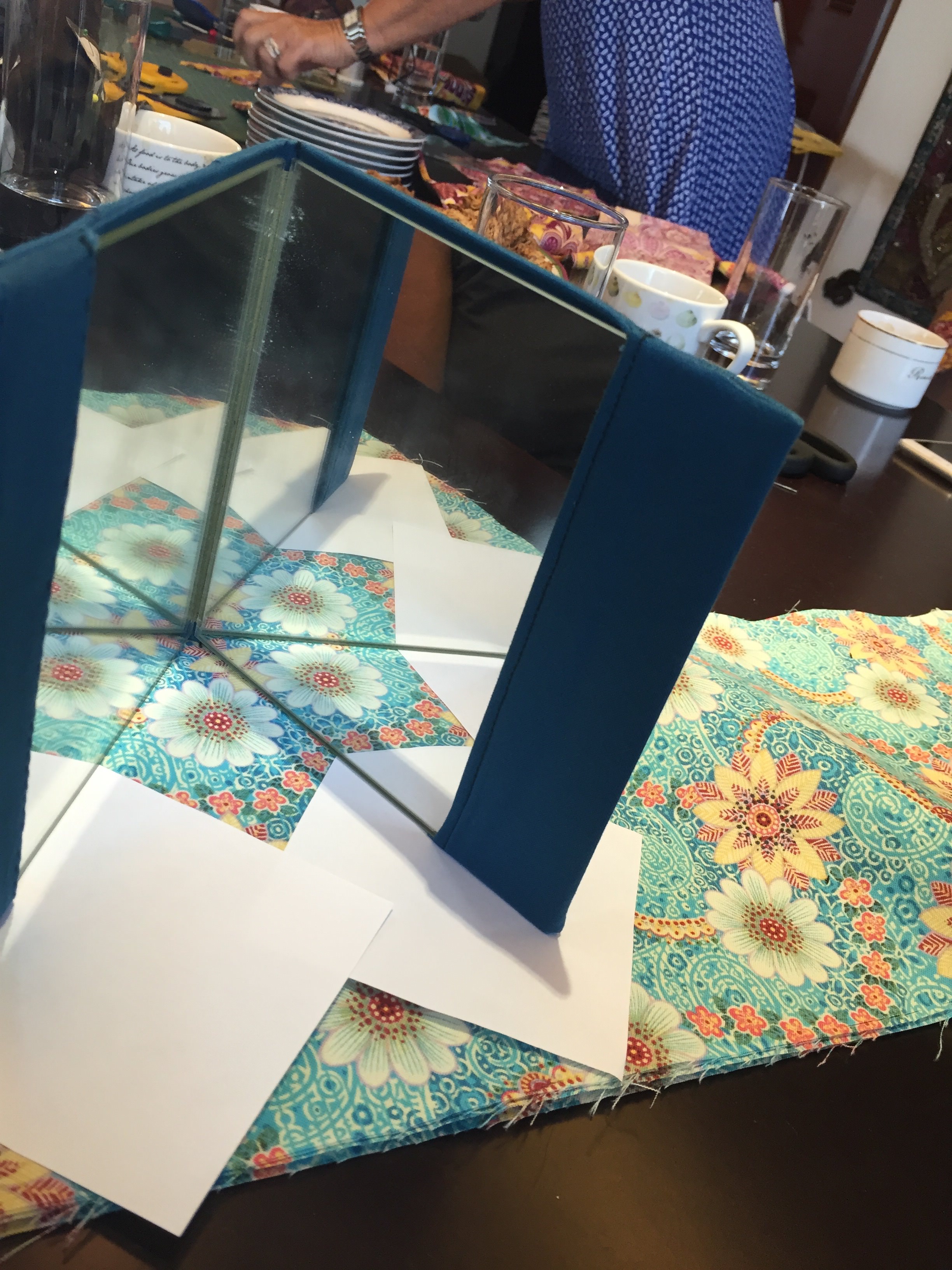
Outside of our regular Thursday meetings Jenny runs the occasional class for our group completely free of charge.  The latest one was for a quilt named stack and whack where the

img_9433 img_9451 img_9454 img_9471 img_9475

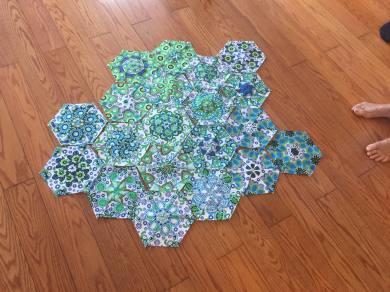
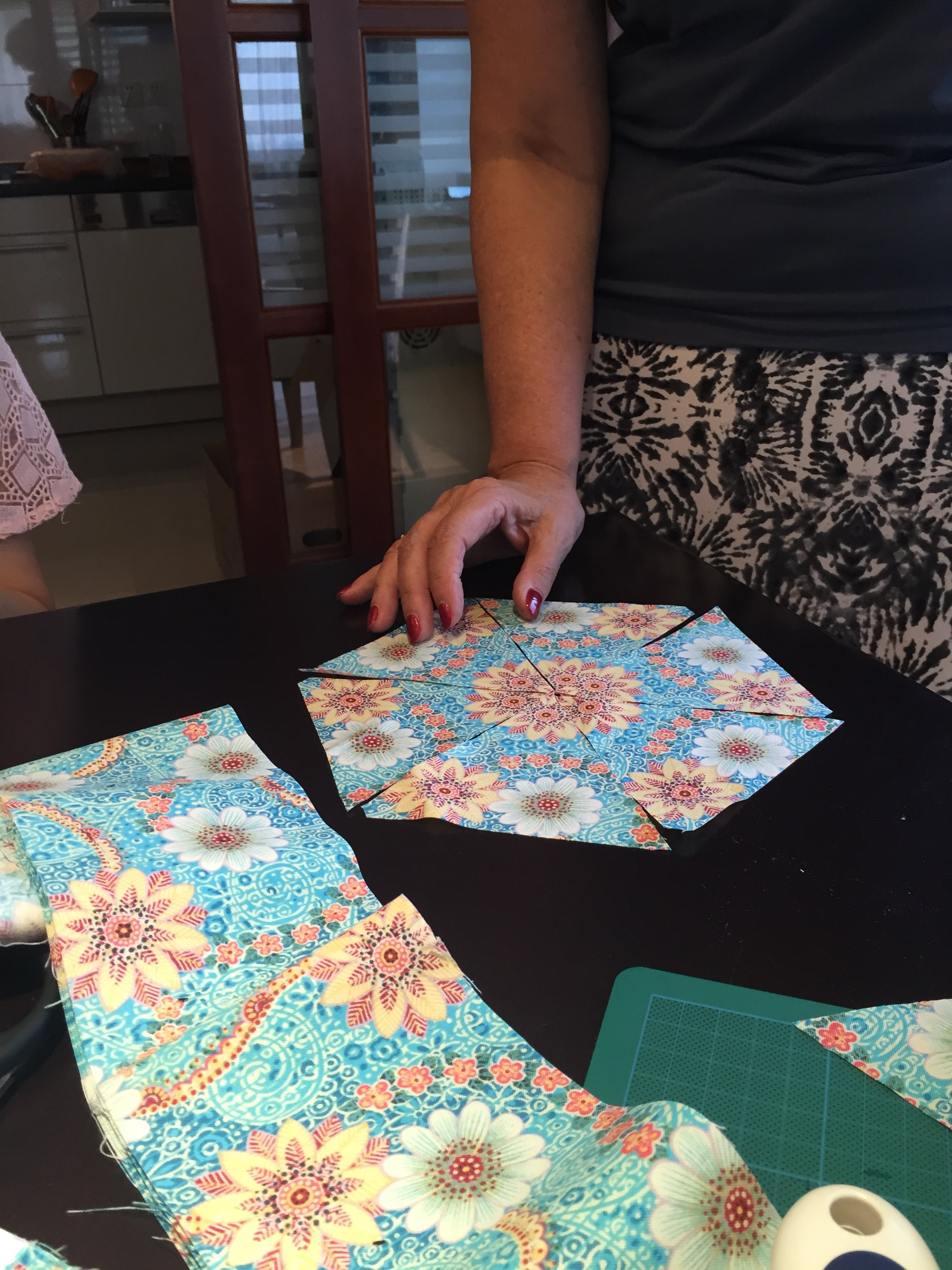
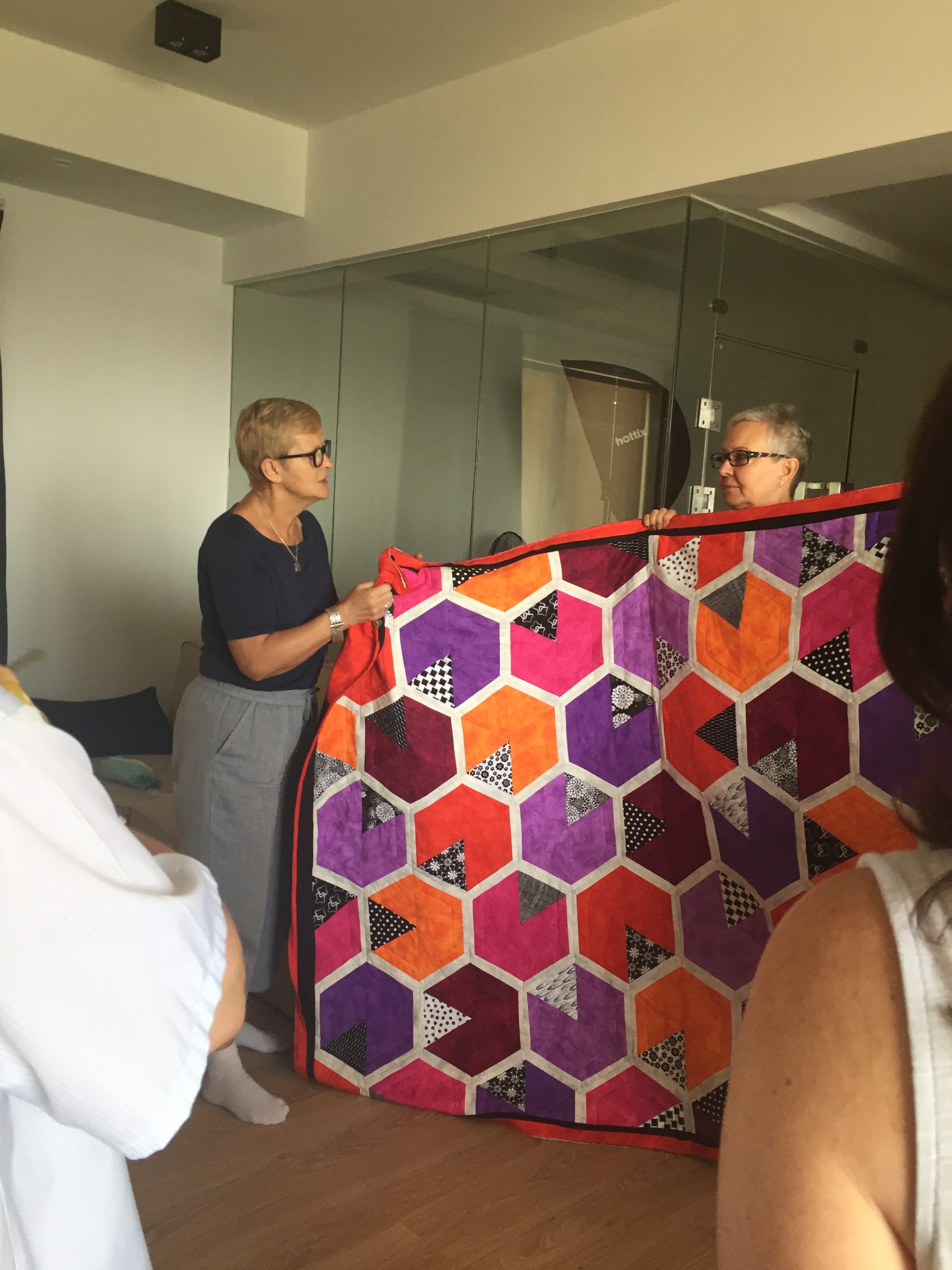
fabrics pattern repeat is exploited 6 times to produce 6 identical strips of fabric that are then layered accurately on top of each other, then secured tightly together and cut into 60 degree triangles.  These are then stitched together to form hexagons each one a different kaleidoscope, which are then stitched together, with or without sashing to form a quilt.

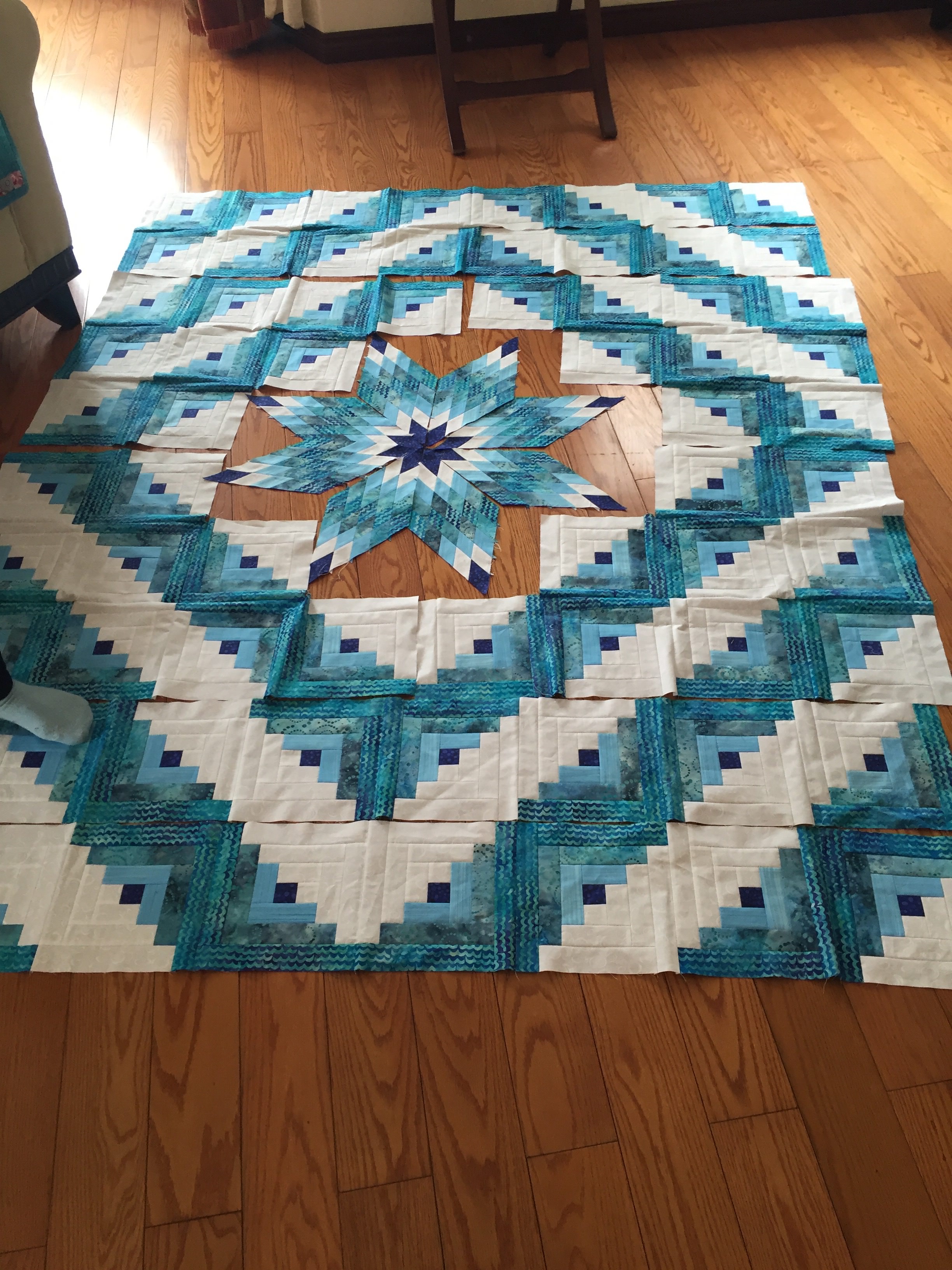
Most of the work we do on Thursdays is hand stitching although some die-hards are prepared to lug their machines to meetings.  Although the group is called a quilting group hardly anyone does any quilting.  Most people are creating patchwork, multi-coloured img_5558 img_6588geometrically arranged fabric.  Jenny hates quilting and normally sends her patchwork tops away to be quilted by someone else, often on a specialised sewing machine called a long-arm that can manage the volume of fabric of a bedspread made of three layers – the patchwork top, the wadding or batting in the middle and the plainer backing fabric.  Some quilt on their own sewing machines.  Some have other projects on the go such as preparing fabric for tie-dyeing, or crocheting for instance.  We all have UFOs, which in quilting speak means unfinished objects and not what you might initially have thought.

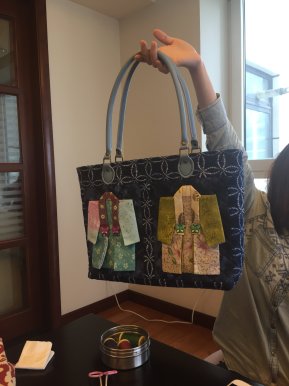
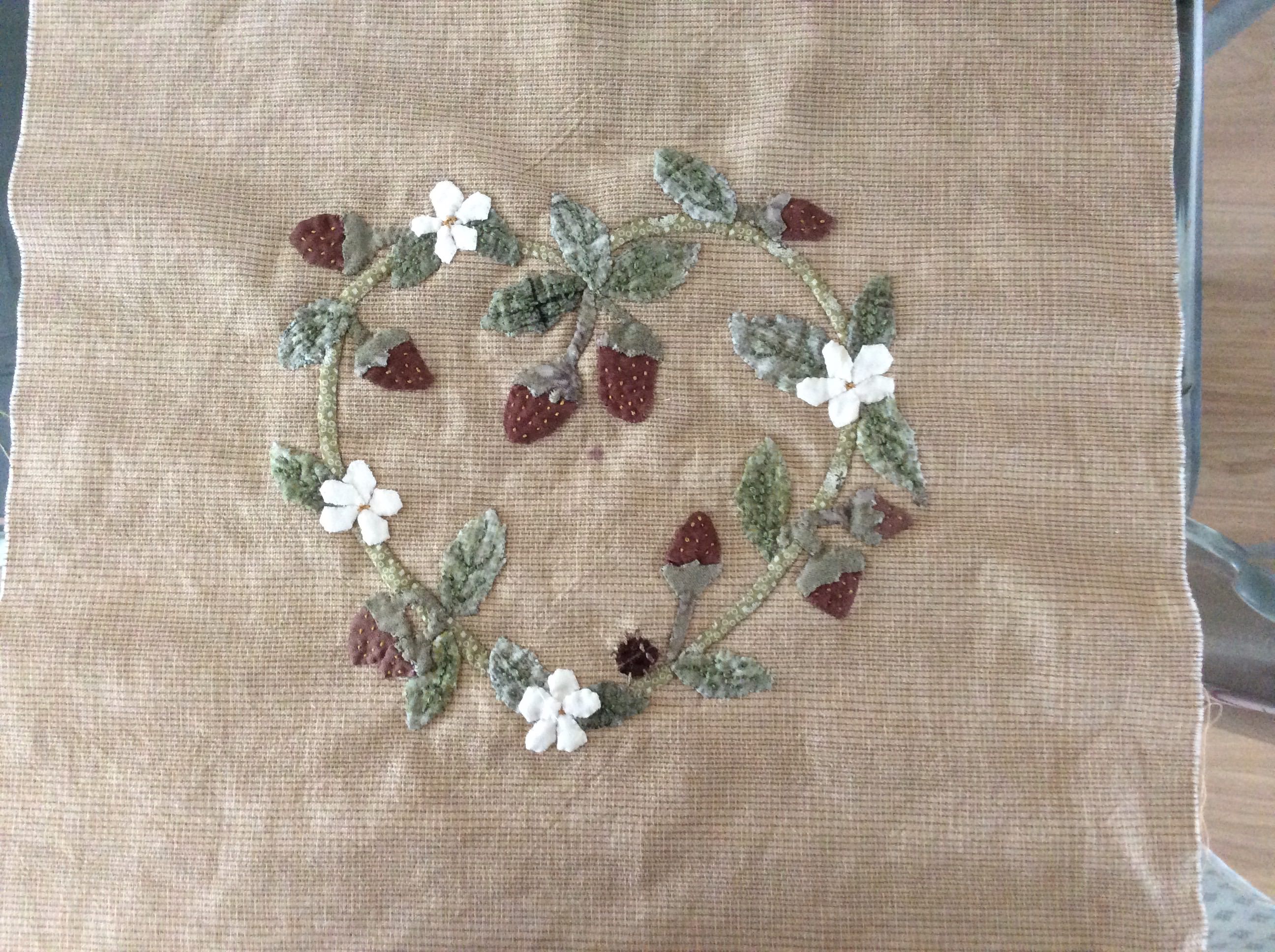
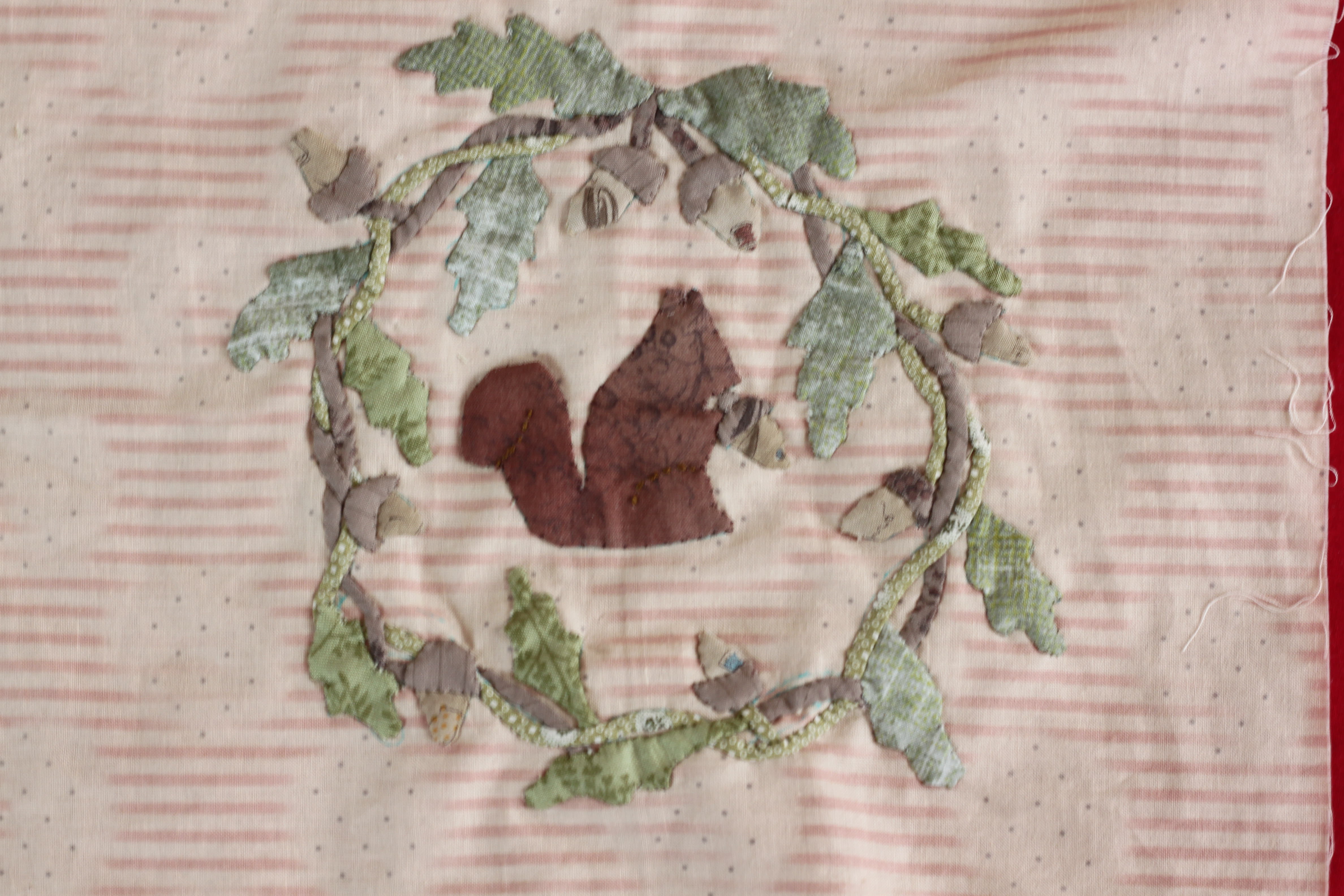
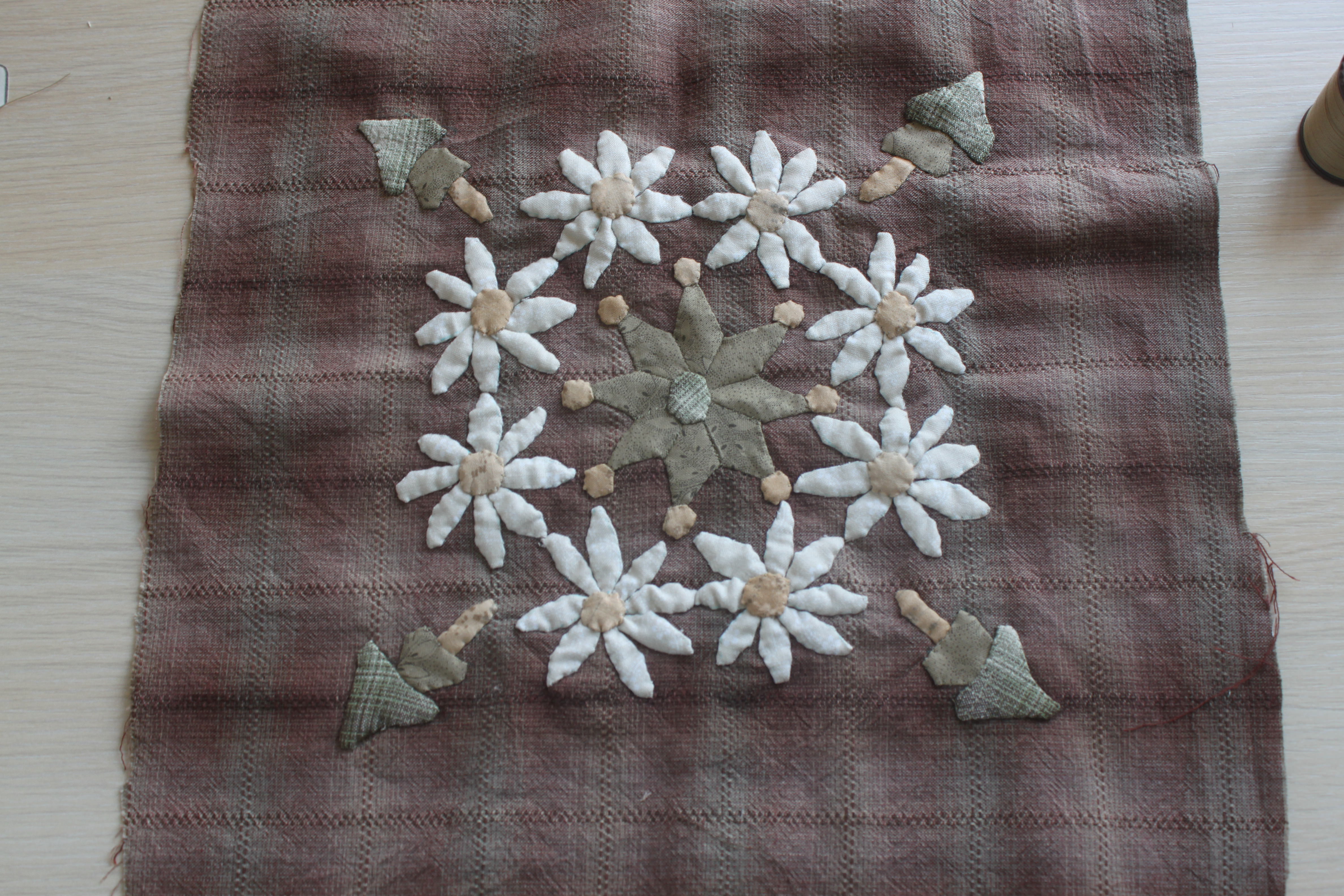
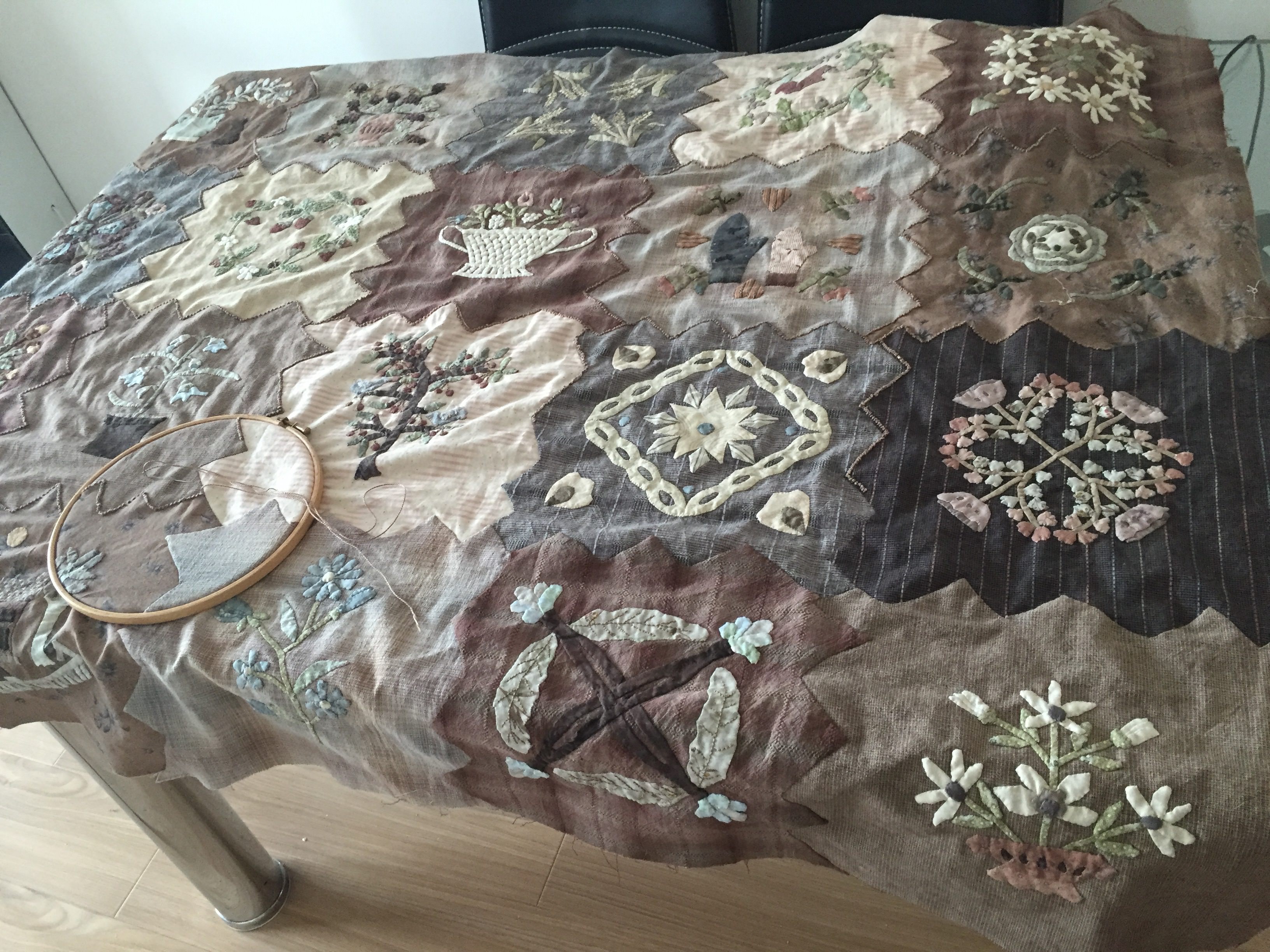
Unusually my quilt was made of appliqué – small pieces of fabric sewn onto blocks of larger pieces of fabric to make pictures, that are then sewn together to make the top layer of the quilt.  The style is called a Baltimore Quilt as it originated in Maryland in the 1840s.  Mine was designed by a Japanese lady, Yoko Saito, who specialises in the Japanese taupes earth- coloured fabrics often used in yukata and kimonos.

img_0369 img_0516 img_0488

For instance one picture in my quilt is a garland of strawberries; another a squirrel sitting in a garland of oak leaves.  Once I had finished all 25 blocks, they are then sewn together with img_8910a zig-zag border between the blocks, appliquéing one block on top of another.  All these seams were then reinforced by embroidering a row of colonial knots on the edge of the appliqué seam (thanks Jenny!).  The central part was then surrounded by a border made from darker fabric appliquéd with oak tree branches with acorns and attached in the same manner.  Here is the partially finished border showing the papers I use to cut out the fabric shapes that go to make the pictures.

img_9415And last month I took it back to the UK and whilst there I completed it – the top layer that is.  I didn’t want to keep it in Shanghai, otherwise I would have wanted to start hand-quilting it. It has already taken up too much of my life this year and I decided that I needed to leave it alone for a while.  Taking it home and leaving it there means that I have now created enough space in my life to start writing again.


Posted in District of Shanghai, Quilting | Tagged , | Leave a comment

Our Daughter Hits Shanghai

It was over a year before our daughter Rosalind made it out to see us in Shanghai.  For the first half of our first year that we had been living as expats in China Rozy had been doing her final year of Chinese at SOAS, The School of Oriental and African Studies part of London University, described recently by img_0594an on-line magazine headline as home to “The biggest single bunch of eccentrics in Europe”. Celebrating a Century of SOAS’.  She was so at home in that academic environment that she decided to carry on her academic studies beyond her BA and try and get a Masters Degree in Chinese.

To earn money to do this she found work at a recently opened M&S Food Hall in Bedford, and through hard work, early morning rises, cycling several miles to and from work each day, she managed to save enough money by the end of March to pay for an  MLitt in Oriental Studies – Chinese at Hertford College, Oxford.  And not long afterwards found out that an awfully nice family from Hong Kong, who since 1911 has been financing scholars at Oxford engaged in furthering Anglo-Sino relations, were prepared to pay for a full scholarship for her.  So having spent six months getting down and personal with the Great British Public she was now able to leave all that behind her and come out to stay with us in Shanghai.  She was offered an internship at Richard’s company for 3 months as a technical interpreter and translator, working as a go-between between the British/Canadian engineers and their Chinese counterparts who are in the process of building a new factory.

Although she had spent 9 months in Beijing in 2012/2013 at Beijing Normal University as part of her SOAS course and 3 months in Taipei, Taiwan on a Scholarship over the summer of 2014, she had never been to Shanghai before.  So when she arrived I was interested to see what she wanted to see and do for the couple of days she had free before she started work.

img_6451I’d like a Korean meal please. So off we went to our local Korean BBQ restaurant for our first meal together in Shanghai.  Then what would she like to do?  I thought she might like to go and see the best that Shanghai had to offer  – The Bund, the Shanghai Museum, you know, the typical sort of things that new visitors and residents like to go and do.  I’d like to go and find a good book shop.  So off we went to the best bookstore I know in Shanghai the 8 storey book store on the Fuyou Road, and others along the same street.  And we amused ourselves for quite a while trying to find just the right sort of Chinese novel that she will be reading as part of her degree this year.  Most of the novels she found were more in the Mills and Book category I understand, but she did manage to come away with quite a handful in the end.  Books are much cheaper in China than they are in the UK, and books in Chinese doubly so.

It amused us to find copies of 1984 and Animal Farm in Chinese for sale and we wondered quite what the local population would make of it.  We did after that make our way over to The Bund, but I don’t think she was that impressed with Shanghai.  No real historical stuff here, as far as she is concerned.  Not like Beijing or Nanjing.

And for the three months that she was with us, she rarely had her nose out of a book when she wasn’t working or sleeping.  She would take one with her whenever she came out into the city with us, reading it on the metro or in a cafe for instance, making up for time lost whilst being a wage-slave for Marks and Spencer.

Watching her read on the metro provided some amusing moments.  The Chinese population are convinced that 老外 lǎowài (definition: 1. foreigner (esp. non Asian person) 2. layman 3. amateur) can’t speak Mandarin and even if they can speak it, it is far, far too difficult for them to read Chinese.  But they are also a nosey bunch of people, so it was amusing to watch a man who was sitting next to her on one trip start to read over her shoulder.  I think he was impressed that a Chinese girl would be reading such a classic novel.  From the side, if you don’t look at her very carefully and specifically if you don’t look at her eyes, her dark brown hair and dark skin tone mean that she could pass off as a young Chinese lady.  But eventually his eyes moved from the book to her face and much to our amusement he recoiled backwards a good foot or so as he realised that she was not Chinese. In Beijing she had a long argument with a man who kept telling her that she must be Russian and who wouldn’t be told otherwise.  In the end Rozy had to resort to asking him Do you know any Russians?  That shut him up.

img_0593Since leaving us in July, she went onto travel around East Asia calling in at Hong Kong, Taiwan, South Korea and Japan before returning for an overnight stopover in Shanghai on her way to Oxford University to begin her MLitt studies, where she seems to be settling in fairly well.
 

Posted in Books, Changning, Independent Shop, People's Square | Tagged , , , , | 1 Comment

An Auspicious Day

On the 8th of September last year I was on my way to Carrefour to fetch some shopping . The 8th of the month is a very auspicious day here in China.  As here the number 8, 八 (bā in pinyin) is consider to be very lucky, as it sounds very similar to the word for wealth  发〔發 in classical Chinese〕(fā in pinyin) the only difference in the sounds being whether you use your top lip or your top teeth to make the word.

The number 8 is considered to be so lucky that wealthy (and mad) Chinese will pay an absolute fortune for a number plate displaying all the eights.  The Beijing olympics were started on 8/8/2008 for exactly the same reason.

On the other hand, the number 4, 四 (sì) because it sounds very like the word for dead  死 (sǐ) , is considered to be very unlucky. Although, believe me, it is not the same, as the former pronounced “sur” has a falling tone and the latter again pronounced “sur” has a falling and then rising tone as indicated in the pinyin notation in brackets, and you have to listen very, very carefully to hear the difference. Note that Pinyin does not use an English pronunciation of its characters. (I don’t envy my daughter  her degree in Chinese by the way.) It is so unlucky that sometimes tower blocks have no 4th floor (and to hedge their bets, there might not be a floor 13, either).

Anyway as a sceptical westerner this fixation on superstition all seems a bit medieval and it was very surprising to me that a bank should consider that it should have a branch opening day based on such superstitions, but I suppose if the IOC were prepared to pander to Chinese superstition its not up to me to argue.  So it was that on my way to the supermarket I came across this bank branch opening ceremony that involved lots of red carpet, red balloons, a line-up of the employees on the edge of the wide pavement being given a team-building pep-talk and speeches from local top guys and finally some firecrackers.  Lots of firecrackers.  Lots of big firecrackers.

Note that this was last September, before the Shanghai local government brought in a total ban on the use of fireworks inside the outer ring road of Shanghai just before Chinese New Year as an anti-pollution measure (sic).  It could not have happened this September.

The firework ban led to a very different New Year than the one we enjoyed (?) when we first arrived in Shanghai when the fireworks went on for 8 days, creating such a big wall of sound that towards the midnight of New Year’s Eve it sounded as if a bullet train was shooting through the apartment as the sound ricocheted amongst the tower blocks.  I regret not having had the wit to record the sound then.  All I did was take a great number of photos of a few of the exploding rockets that burst forth at a rate of maybe 10 a minute over the 20 storey buildings around us, or the firecrackers in the street that were set off both before businesses closed for the holidays and as people returned to work.

I did however video some of the bank opening as I stood and watched the spectacle, as once they set off the firecrackers it was too good to miss.  To imagine the sound of Chinese New Year as it was in 2015, consider this noise a thousand-fold.


And for 2016 Chinese New Year absolute silence. The obedience following the ruling was truly amazing.


Posted in Changning, Event | Tagged , , , | Leave a comment

China Never Ceases To Surprise

As I have not really published very much since this time last year, my stories of Shanghai, are now necessarily going to be sent to you out of date and most probably of all out of sequence.  So from now on this blog is going to bounce around all over the place, both in time and location.  I hope it does not make you too dizzy.

In my last post I explained that I had abandoned writing because of the frustrations of operating a blog behind China’s Great Firewall and how the frustrations had got the better of me.  That was not the only reason, only the last straw.  I had spent a long time trying to find a way of loading up videos that I had taken to show you.  I failed.  I had also spent a lot of my time over the year on a photography course, been leading guided walks and I also joined a quilting group.  All took up valuable exploring or writing time, but they meant that I was meeting more people and forming some great friendships, so that was a sacrifice worth making.  But a snide comment from someone back in the UK about my writing about personal things on the internet was the final nail in the coffin.  So I stopped.

But this time, when I went home in September, many of you expressed regret that I was no longer writing, and that has given me the impetus to start blogging again.  I am out of practice so forgive me whilst I get myself back up to speed. I think I have also found a way of sending you some video clips. If you don’t like what I have to say, you don’t have to read these letters home.  For me they were, and I hope once again will become, a way of processing my thoughts about this extraordinary life I have been living for nearly two years.

I was, as I said, recently back home.  I have old parents and young adults back in the UK whom I care deeply about.  We have left pets at home under the care of a house sitter and a home that is in the middle of a programme of building work. Also we have friends and relations all over the country and it is impossible to see everyone on a fleeting visit.  It is difficult to leave all this behind after 3 weeks and return to life in Shanghai and there is always much to talk about with Richard when I return.

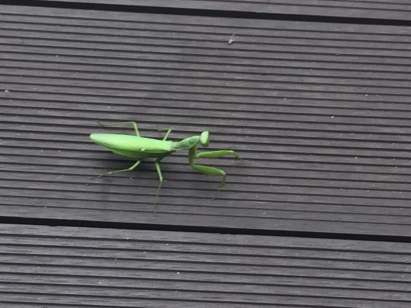
For most of last week he was working his usual long hours and I, due to jet lag, was falling asleep by 8pm so we had little opportunity to catch up on the most pressing issues.  So on Saturday we ended up sitting outside at a Japanese cafe next to our metro station (we were on our way to an art gallery, but didn’t quite make it) having a mug of coffee and going through carpentry and nursing homes, degrees and ……when Richard felt something fall on his back and climb up his collar and tickle his neck.  Not knowing what it was, there was a bit of a reaction from my man, so I scooped it off his back and onto the floor, and we img_0897continued to watch its progress around the cafe furniture.  A Japanese girl sitting at the next door table reacted to it as if it were a spider, screaming a little, jumping from her chair and retreating well away. She was very grateful when Richard ushered it on its way towards the cafe next door.  I’d never seen a 螳螂 (tángláng) or praying mantis in the flesh before, though of course I’d seen them on the BBC  wildlife programmes.  About 4″ long, I was fascinated by its huge eyes and its rocking movements.  I assume that that helps its compound eyes to see.
 

There is a Chinese idiom from the Daoist classic Zhuangzi 庄子:”The mantis stalks the cicada, unaware of the oriole behind”

which means to pursue a narrow gain while neglecting a greater danger.

China never ceases to surprise.


Posted in Changning, Restaurant | 3 Comments

A Year’s Worth Of Books

Followers of this blog will know that I have not written for a long time.

Below is the last blog post I wrote, but never published.   It will go some way to explain why I walked away from writing online about our lives in China.


I’m rather annoyed.  In fact, I’m very annoyed.  No, I’m seething.  I have spent days writing this blog post in between everyday life in Shanghai and trying to grab time when the internet is up and working, to type all that I wanted to say about the books I’d read in 2015.  And then somehow, today, despite the whole post being saved time and time again as I wrote a little bit more, I’ve managed to lose the whole lot. Gone. Just like that.  Wordpress has forced me into using their new version of their blogging software and somehow I’ve just managed to send about 15 hours work into a puff of air.

So when I can bring myself to fight the machinations of the software and Shanghai’s intermittent internet and the Great Fire Wall, I shall recompose what I wanted to say and break it down into several posts so that I can’t lose too much work in one go if crisis hits and you won’t have to read much in one go either.  In the meantime, enjoy the pretty pictures.

Posted in Books, Changning | 1 Comment

Inner Mongolian Restaurant: Xi Bei You Mian Cun – Xi Bei Oat Noodle Village

IMG_3417Richard was the first to go to the Inner Mongolian Restaurant, taken there by his Chinese boss who hails from that northerly province of China that hugs the northern desert country of Outer Mongolia.  We went with Kirsty, Richard’s Scottish development manager who is here in Shanghai to help out for a year, and her boyfriend James who was here for the Christmas holidays.

It is a chain of shops and has the same feel, decor and cleanliness of the Taiwanese dumpling chain Din Tai Fung.  (Whilst we were there again, a week or so ago, the waitresses were polishing the chair legs at the end of service – a rather exceptional procedure in most eateries here in Shanghai.)  The tablecloths were red and white french bistro style and the chefs were on display behind a large glass panel along one side of the restaurant.

IMG_3419We had more less the same dishes that Richard had had with his boss – we believed that he would of course know what was best – and what we ate was delicious. Once the waiter had taken our order, he turned over a medium-sized sand timer that he had brought to our table.  Richard said that if they didn’t give us all our food by the time the timer finished then we would have the meal for free – but somehow I think this got loss in translation as the last time we went, they failed to deliver, but we still had to pay for everything.  (Perhaps we should take Rozy there when she is visiting and she can then find out for us what it really is all about.)

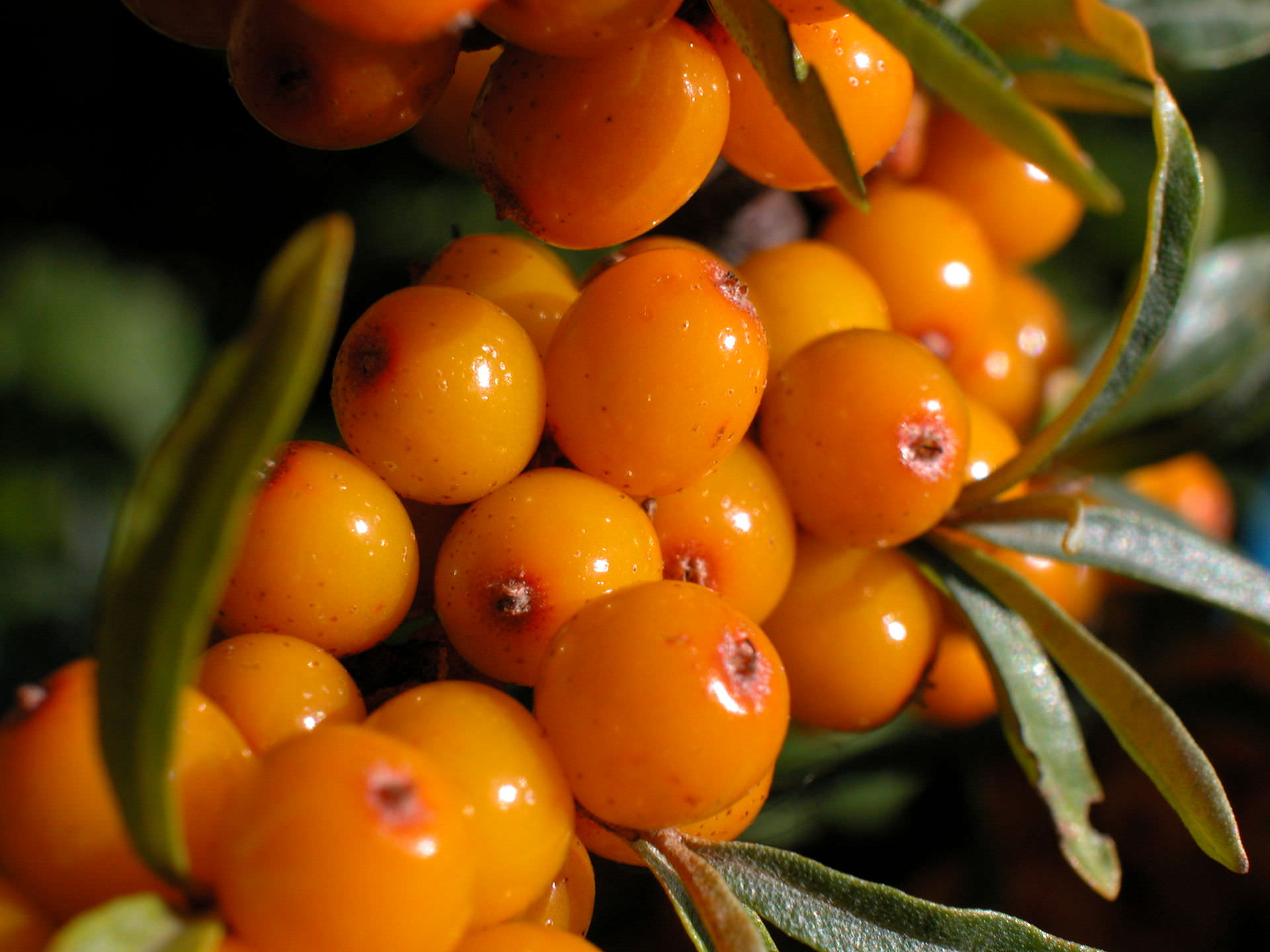
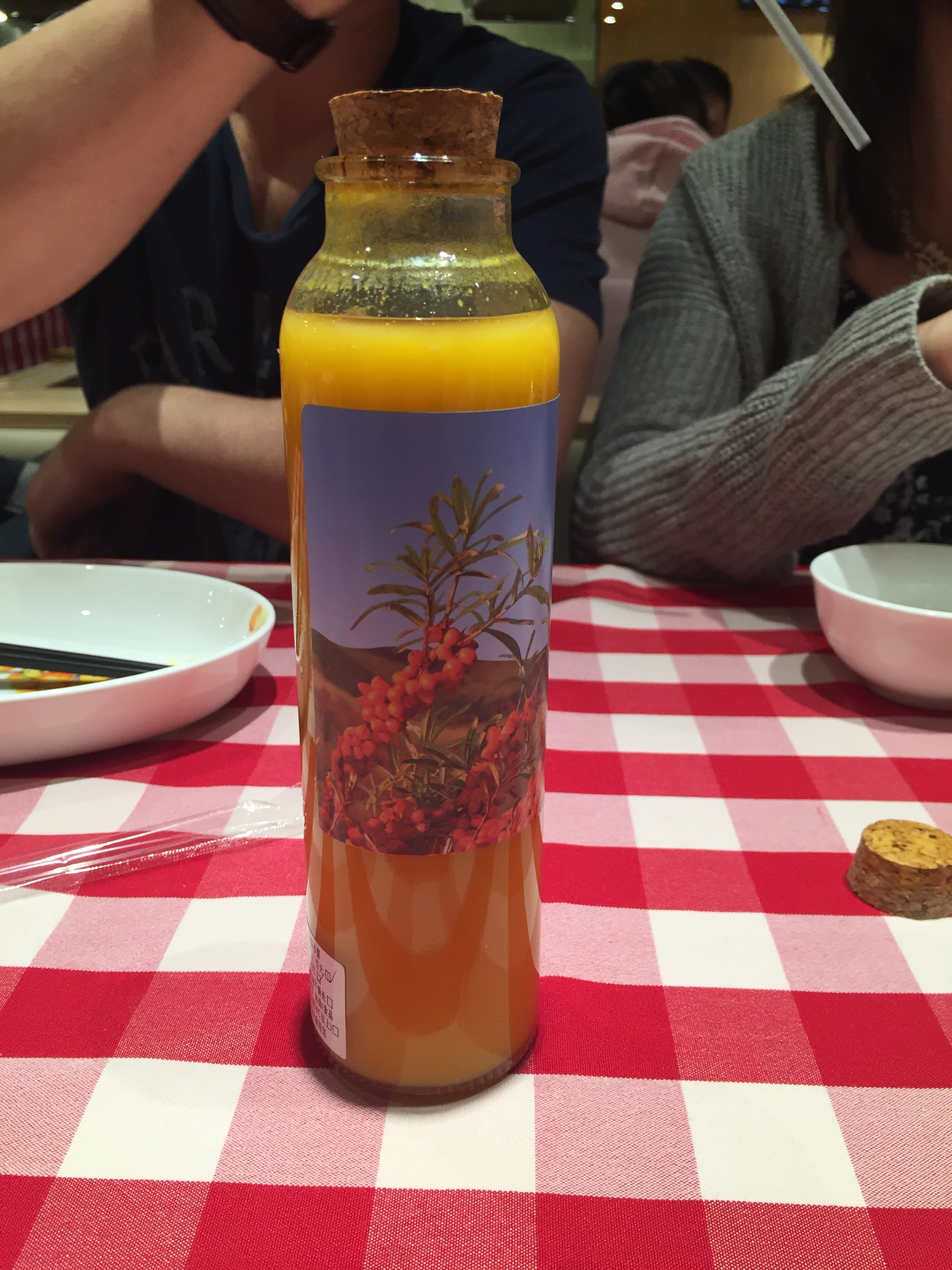
Hippóphae_rhamnoídesWe started with sea buckthorn juice squeezed from the orange berries of the spiny Sea Buckthorn (surely rather misnamed if it is found in the majority of its natural habitat so far from the sea – from around Mongolia west across the semi-desserts of China and southern Central Asia through central southern Europe and around the coasts in Europe where the sea salt rather than sand kills off its competition), and delivered in a cork-IMG_3422IMG_3421stoppered bottle.  In fact it seems to be the signature of the restaurant chain as the restaurants’ plates were decorated with images of sea buckthorn branches.  It was a beautifully flavoured drink and if you are ever out foraging and find some I urge to pick some (although I expect they will need a lot of sugar to make them palatable).

IMG_3423Next we had lamb kebabs, flavoured with cumin – a meat and spice you don’t see in this part of China.  The Han Chinese appear not to eat lamb and they don’t use cumin either.  And after a year away from the UK we have found ourselves hankering after both flavours, alongside marmite, chocolate, marmalade and British bacon (although that’s probably Danish).


IMG_3424IMG_3425Then came a dish of oat pasta rings – the pasta rings stood stuck together on their ends and were stuffed with a red and green sauce made with celery and with hindsight I’m not sure what, perhaps peppers, or pumpkin  – Richard must know.  It is very unusual to find pasta made with oats – usually they are made with IMG_3426IMG_3429wheat or sometimes rice flour.  But in Inner Mongolia the climate is not capable of growing wheat and as in Scotland oats they are the grain of choice.  To this we added a plate of green vegetables, as I find myself craving such things here in  China.

IMG_3433We ordered some green vegetables and a leg of lamb each for gnawing at, in medieval fashion, and finally some flat breads filled with diced meat, onions and peppers. To finish off there was homemade yoghurt topped off with honey just as the Greeks do it.

All in all a welcome respite from the more normal food of the Han Chinese we have been eating over the past year.  If you are in Shanghai and are interested, this is in the Shopping Mall on the north side of Zhenbei Rd Metro on Line 13, on the 4th floor I think.


Posted in Putuo, Restaurant | Tagged , , , , | Leave a comment