
I was first introduced to the idea of magnetic levitation by Professor Eric Laithwaite in A Royal Institution Christmas Lectures To Young People in 1966. I must have been 5 at the time. I still remember the black and white TV programmes with its demonstrations of linear motors and magnetic levitation systems which we watched en famille. My father was there with us – he, like Eric is a Lancastrian, in fact they were both at Manchester University at the same time doing first and second degrees in Physics for my father and Electrical Engineering for Eric despite Eric being 5 years older than my father. Eric had spent the war in the RAF, whilst my father had still been at school. I loved the way that Eric could get the small lab vehicles to levitate above a track using electromagnetic fields not only to move the vehicle above a guided track, but also to hold its position relative to the track and thereby making it stable. The lack of friction in these systems allows the objects to travel at high speeds and I clearly remember one of the objects flying high into the roof of the Royal Institution Lecture Theatre as Prof. Laithwaite demonstrated how well the system could operate against gravity. Some of that thrill is conveyed in this video from 2013 from the RI, this time using a superconducting magnet to run around a Möbius strip (something else that has always thrilled me – it only has two surfaces one continuous edge and one continuous face). The linear motor was naturally suited to use with maglev systems as well. In the early 1970s, Laithwaite discovered a new arrangement of magnets, the magnetic river, that allowed a single linear motor to produce both lift and forward thrust, allowing a maglev system to be built with a single set of magnets.
This science over the years developed into the Magnetic Levitation or Maglev train. The first one was built at Birmingham Airport in 1984, but it only travelled the short distances between the airport, Birmingham International Railway Station and the NEC and went out of service in 1995, because its electronics became out of date and there were no spare parts. Conventional tracks need monitoring every inch of their length every 72 hours. As there is no contact between the track and the Maglev train this costly maintenance is done away with.

The Maglev Track

Shanghai Transrapid Train
The Shanghai Maglev train aka The Transrapid is thus not the first in the world magnetic levitation
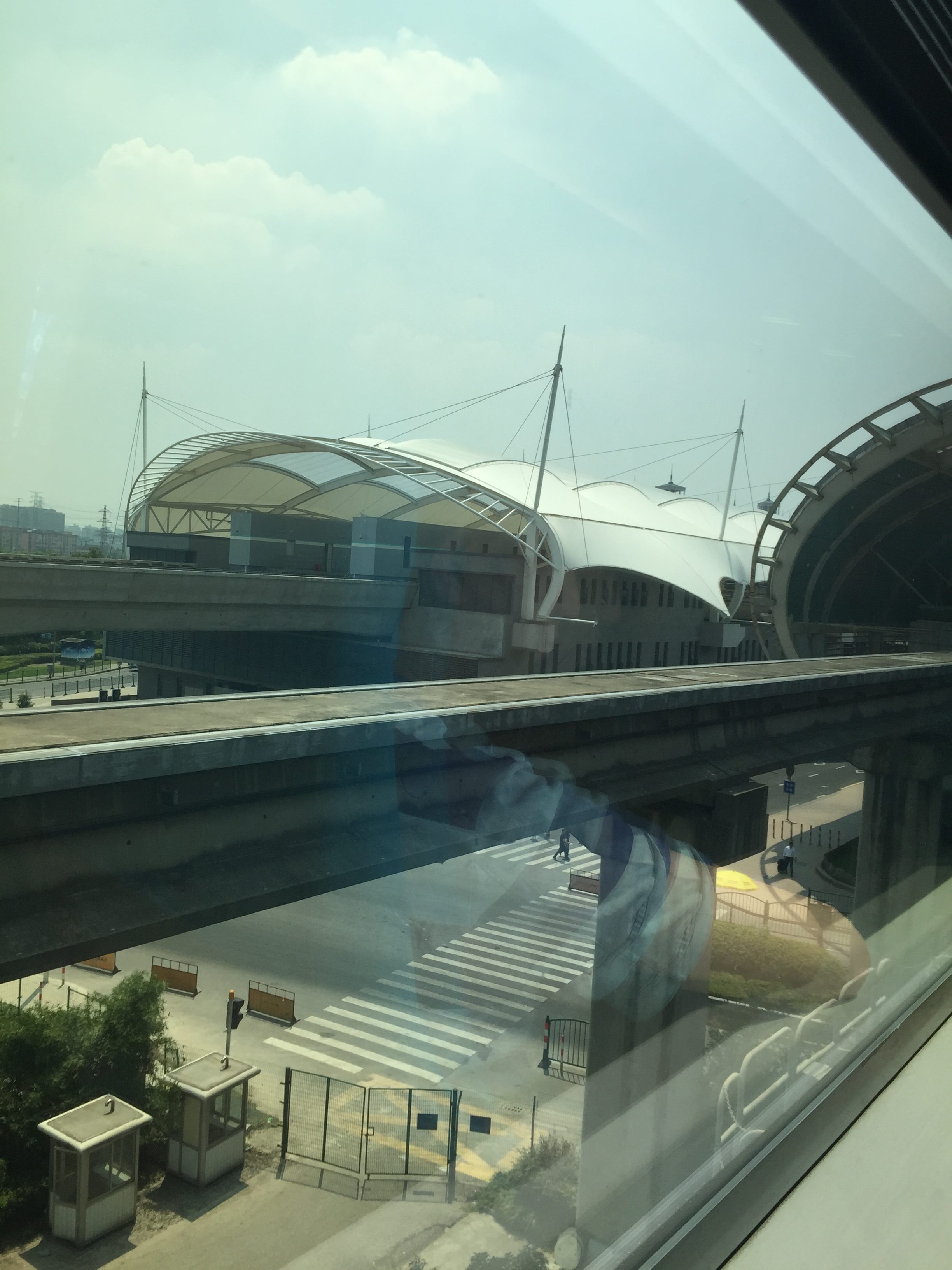
Longyang Lu Metro Station

Pudong Airport From The Maglev
train in the world, but it is the world’s first commercial maglev high speed line. It runs between Longyang Lu metro station and Pudong airport. It was built in 2004 and has a top speed of 430 km/h (270 mph) and

Banked Curves

Banked Curve of Other Track In the Foreground
I used it on my way to go and meet Charlie and Ella off their Lufthansa flight. Just to see what it was like. It is a modern bullet-style train similar in style to those that now run all over China and runs on the solid track significantly banked on the bends.
That’s where the good story ends. At the moment the Maglev only goes from the airport to Longyang Lu metro station which is still a long way out of central Shanghai. To get from our apartment to Pudong airport is takes 88 minutes from metro station to metro station with a mile long walk at our end to Yilli Lu Metro, with two changes involved along the

Maglev Ticket
way. To get to Longyang Lu it takes only 45 minutes, but the Maglev train only runs every 20 minutes, so once you have swopped stations at Longyang Lu put all your luggage through yet another x-ray machine (they are at all metro/train stations and important state buildings) and bought your separate Maglev ticket – you can’t use the Shanghai Card which you can use on all other journeys on buses, taxis and metro journeys in Shanghai – and stood around for 20 minutes for the next train if you just miss

Train with Seats Passengers With None
one, and then walked the mile at the other end from the Maglev station to the Airport Terminal you will still only be 4 minutes earlier than had you used the metro all the way as well as having paid the equivalent of an extra £5 for the privilege. There were no seats on the platform and although the next train was standing there waiting, you were not allowed on it until about 3 minutes before it left. Even if in this communist country you have bought yourself a VIP ticket. Not only that, but the train doesn’t reach
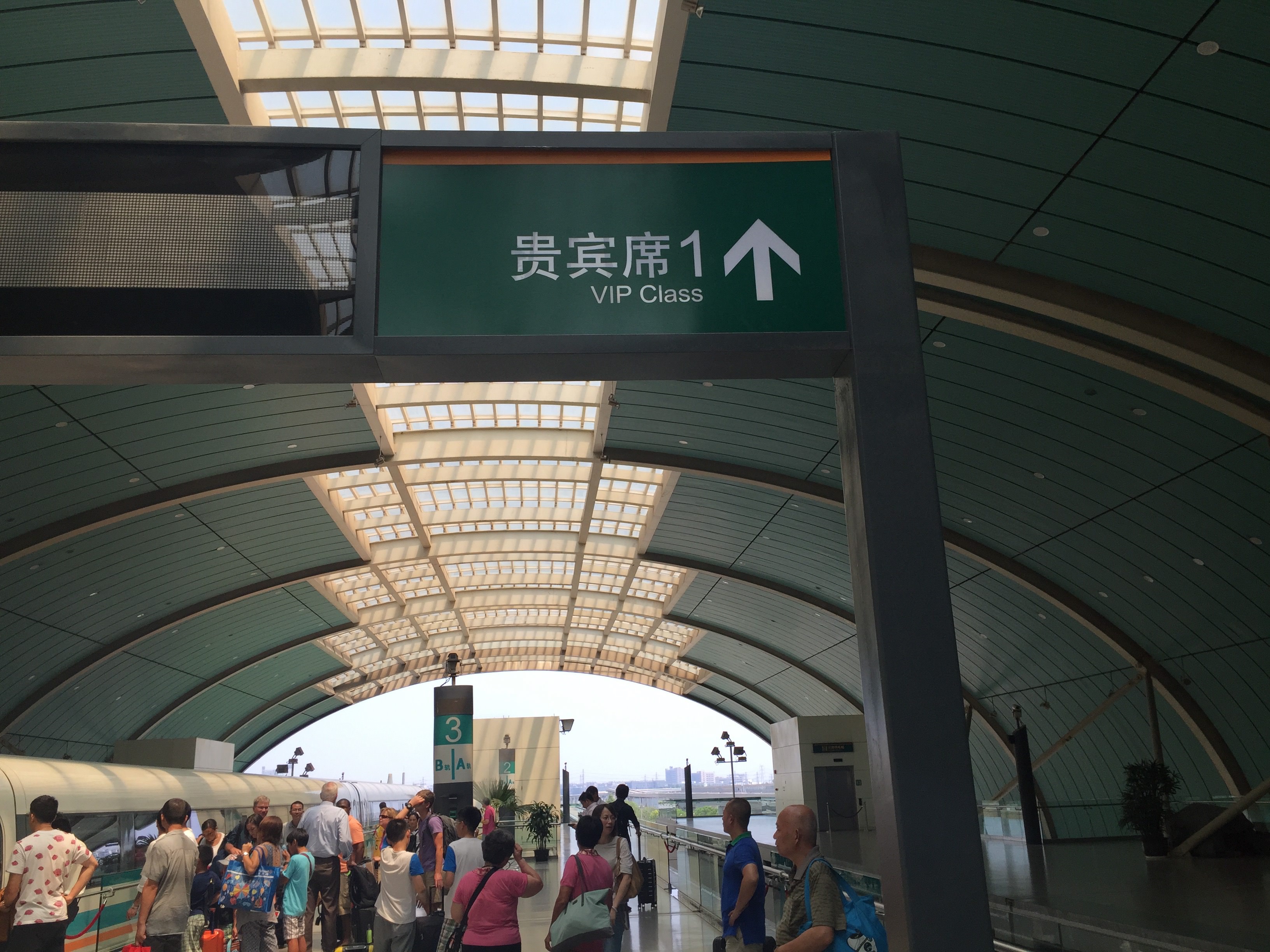
VIP Class
its maximum speed on the journey. It only did 301km/h max on the day. I have read somewhere that this is because part of the track is sinking in the thick alluvial soils of the Yangtze River Delta, which are shrinking from water extraction, to such an extent that 130km/h have had to be shaved off the maximum speed to cope with the misalignment of the track. (Shanghai has settled more than 16″ since the 1960s).
The reason why the Maglev stops so far outside the centre of Shanghai is that it was planned to join up Pudong the International airport at the coast on the far eastern edge of the city to the Hongqiao Airport, not far from our flat, which deals with internal domestic Chinese flights and then it was supposed to go onto Hangzhou which is now served by a high-speed railway built in 2010. So there seems to be no sign that the Maglev is going to be extended westwards beyond its rather daft endpoint anytime soon.
I understand that there is a museum about the Maglev train at Longyang Lu, but I didn’t have much time – I’d only allowed 2 hours for the journey to get to the airport. The taxi back was much quicker.
It was all a bit of a let down really.

 Pearls From The Orient
Good evening!
Thoroughly enjoyed reading your Blog.
I wanted to ask if there is anyone you can recommend here in the North West for me to interview on the Maglev? I’m putting together a TV and radio package about the the Maglev and whether this could become a method of travel one day here in the region?
Kind Regards,
Donna M Sladen 🙂
I can be contacted at: DMSladen@uclan.ac.uk or donna.sladen01@live.co.uk
LikeLike